Course/The Seventy-Eight Cards
Lesson 01
How to study a card
Observe first. Interpret second. Research third.
This is the pattern you will use for all seventy-eight. Traditional first. Then look. Then notice which layers are speaking. Then practise.
If you skip the pattern, you will have favourite cards and a fog around the rest. If you keep it, an unread card is still approachable.
The pattern
Traditional first. What has this card been known to mean? Learn the note. Honour it. Write it in your own words so it is in your mouth, not only in a book.
Then look. What is actually in the picture? People, objects, weather, direction, colour, what is missing. You already know the card's name. Do not let the name steal the looking. We will train looking as a full skill in the next module. Here, I need the habit planted: after the traditional note, you still sit with the image.
Then layers that are speaking. Suit and element. Number or court rank. Where it sits in the Fool's Story if it is a Major. A symbol that will not be quiet. A feeling in your body. Not every layer every time. The ones that are actually loud.
Then practise. Use the card. Pull it into a question. Write. Come back tomorrow. A card you have only read about is not a card you can read.
Why traditional first, in this module
When you are learning a card, the traditional meaning is the floor. You need a floor. Later, at the table, you will often observe before you fetch the library. That is the reader at work. This module is the student at work. Learn the note, then see past it, in that order, so you are not inventing a card that already has a history.
If your look contradicts the traditional note, do not panic and do not swagger. Write both. Ask why. That tension is often the reading.
Worked example. Three of Swords, through the pattern.
Traditional first. Heartbreak, sorrow, painful truth, a cut to the heart. Keep it.
Then look. A heart. Three swords. Rain. Grey. No person. No ground. The wound is unattended by a human figure. That is already more than the caption.
Then layers. Swords: air, mind, words, conflict. Three: the first made thing after a meeting, a triad, expression. In a spread about work, those swords might be three sharp facts. In a spread about love, the traditional heartbreak may be exactly right. In a spread about a decision, the rain might be relief after saying it.
Then practise. Sit with it in the Practice Room. Write a question. Let the card answer that question, not a poster.
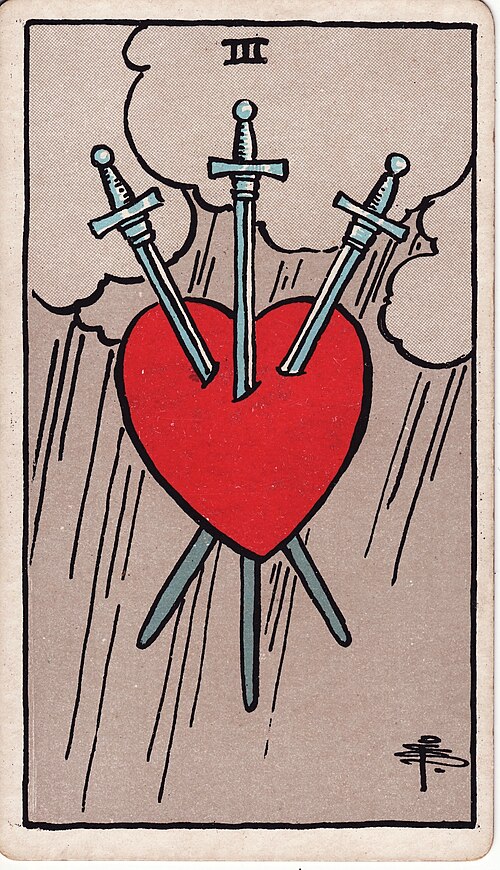
Three of Swords
Three
Activity
Run the pattern once, on paper
Pick any card you think you already know. Four headings: Traditional. Look. Layers speaking. Practise. Fill them. If a heading is thin, that is the part of the pattern you usually skip.
Practice
An unknown card, same pattern
Draw a card you like less, or one you always blank on. Do not skip it. Traditional note if you have one, even if shaky. Then look for a full minute. Then name suit, number or rank, and one thing the image is doing. Then write one question this card might be asking you. That is the pattern. You will use it seventy-eight times.
Open the practiceReflection