Course/The Seventy-Eight Cards/Major Arcana, card by card
Part 14
Death
Observe first. Interpret second. Research third.
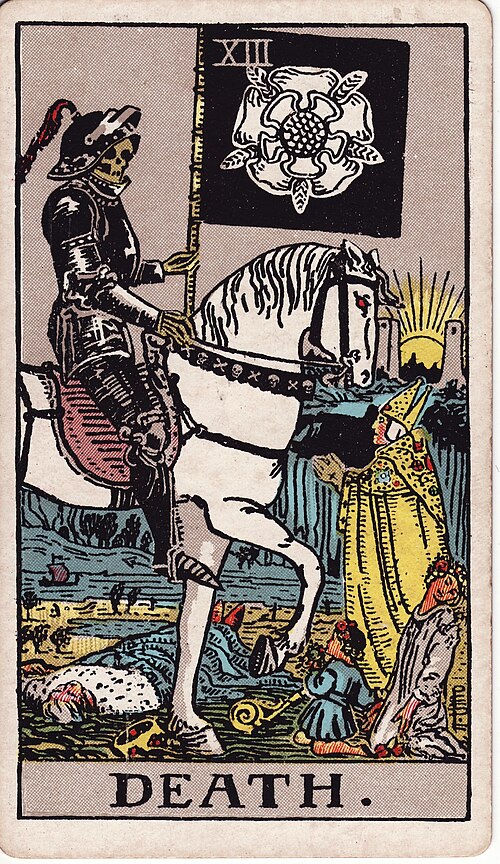
Death
Major · XIII
Traditional foundation
Traditionally, Death is ending, necessary change, the stripping that makes a next life possible. In Rider-Waite-Smith teaching this is not a corpse-count and it is not a promise of a physical death. Waite painted a skeleton in armour on a pale horse, moving through a scene of people in various relations to the end. The old books say transformation. They also say: something is actually over.
A black flag with a white rose. A king fallen. A child kneeling. A maiden turning away. A bishop in gold, hands raised. A river. A sun between two towers on the horizon. The traditional reading is: the old form cannot continue. Let it go, or be dragged. Rebirth is in the card as a rumour of sun, not as a cute caption that skips the skeleton.
Keep that. Then look. Traditional Death can be a job ending, a self ending, a chapter, a grief, a relief. It can also be stagnation wearing black, a person who collects endings, or a refusal to look at the king already on the ground. The river and the sun between towers will tell you whether this death has a far bank.
Where it sits in the deck
Thirteen is the unlucky number in the folk mind, and in the sequence it is the honest one after the Hanged Man's pause. Number thirteen can be reduced to four: a new structure wanting to exist after the old one falls. Use that only if it adds. In the picture, structure is already on the ground in the form of a crown.
Temperance is next. After ending, blending. Feel that neighbour. Death clears. Temperance mixes what remains. If you read Death as the whole transformation, you will skip the alchemy that comes after the horse has gone by. The Hanged Man yielded. Death takes. Temperance will have to live with what is left.
Look at this image
Look at who is meeting the horse. The king is already down, crown off. The child looks up, almost curious. The woman beside the child turns away, wilted. The bishop faces the skeleton as if liturgy might still work. Why four different relationships to the same rider in one frame?
The flag is a white rose on black. You have seen a white rose in The Fool's hand. Here it is an emblem on a banner of ending. Why? The sun is not high like The Fool's. It is rising or setting between two towers, far away, across a river. Ask whether this is dawn or dusk in your question. The picture will not caption it for you.
The horse is white, the armour is black. The skeleton is bony and busy, not lying still. This Death is in motion, looking forward, not at the fallen king. Notice the river, the boat on some printings, the ground the hooves are on. Ask what is being crossed, and what cannot come.
Symbols worth investigating
The white rose on the black flag is the living thing on the banner of the end. Investigate whether this death is clean, even beautiful in its honesty, or whether the rose is a consolation you are using to skip the bone. The Fool carried a rose toward a cliff. Death flies one on a flag. Same flower, different job.
The sun between towers will show up again in The Moon. Here it is a distant gate. The river is a boundary, a Styx if that language helps, or simply the fact that you cannot walk back to the king's body once you have crossed. The bishop's gold against the skeleton's black: office meeting the thing office cannot stop. Ask which figure in the scene you are.
Colour in this card
Black armour, white horse, gold bishop, grey-blue river, a pale yellow sky at the towers. The black is doing the absolute of it: this is not a pastel change. The white of the horse and the rose is the strange brightness inside the ending. If the gold of the bishop feels like faith that can face a skeleton, keep it. If it feels like pomp at a funeral, keep that. Colour here is the climate of a bank at the edge of a life.
Number
Thirteen as the folk unlucky, and as the first number after a round twelve. In this card it is the quality of something that will not fit a neat year. It can feel like a rupture in the calendar. If you reduce it to four, ask what new square wants to be built after the throne is empty. Do not use the reduction to make Death nicer. The number can be jagged. Let it.
An astrological layer
Scorpio is the usual correspondence. Scorpio as the deep cut, the taboo, the regenerative, the jealous guardian of what is dying, the honesty about sex and death and power that polite cards skip.
That can deepen a reading about a necessary underworld, about a bond that has to compost, about intensity that will not be managed by Justice's hall. If Scorpio would only be a spooky sticker, skip it. Use it when the horse is actually in the psychological deep, not when someone just wants a gothic mood.
What is this card doing?
Forward, inexorable, clearing. This is movement that does not negotiate with the king. The energy is a cut across a landscape, then a distant light.
Feel whether you are the rider, the fallen, the child, the one turning away, or the one in gold trying to bless it. Death energy can be the kindest thing on the table when a form is finished. It can also be a person who only knows how to end things.
Light and shadow
Light. An honest ending, met. Space made for a sun that is not here yet. The rose on the flag: life still true inside the black.
Shadow. Refusal to look at the king on the ground, or a habit of killing what is merely difficult. Numbness. Drama about death so you never have to do the small ending in front of you.
How this can show up
Self-work: the identity that is over, the grief, the compost, the version of you that cannot go over the river. Work: a role ending, a business, a chapter of a career. Do not promise a rebrand as a way of skipping the skeleton. Look at the sun between the towers. It is far.
Love can be a relationship ending, or a form of the relationship ending while the people remain. It can be the death of a hope. Ask which of the four figures you are, and which your person is. A child looking up and a bishop bargaining are not the same reading.
Same card, different reading
As a future, Death often says a form will end. As advice, let it. As a past, you are already on the far rumour of the sun, or you are still standing over the king. As a person, the closer, the surgeon, the one whose presence ends a game. Position and question decide whether that is mercy.
After The Hanged Man, the pause is over. Before Temperance, there will be mixing, but not yet. Next to The Fool, an ending that is also a cliff. Next to The World, an ending that knows it is a cycle. Concrete example: Death in the advice position of a should-I-keep-trying spread, sitting next to the Four of Pentacles, is not the universe will transform this if you hold on. It is the king is already down. Stop paying to keep the corpse on the throne.
Activity
Describe before you interpret
Cover the traditional notes above. Look at the image. Write only what you see. People, objects, weather, direction, colour, what is missing. No meaning yet.
Activity
Ask the card
Which figure am I in this scene: king, child, maiden, bishop, or rider? What is already on the ground that I am still governing? Is the sun between the towers rising or setting in this question? What is the white rose doing on a black flag here? What cannot cross the river, and am I trying to smuggle it?
Practice
Practise this card
Look at Death in the Practice Room. Do not write the word transformation first. Name the five encounters: horse, king, child, woman, bishop. Write one sentence for each about a current ending. Then look at the sun between the towers and write how far away the light actually is. Honesty. No rescue.
Open the practice