Four of Cups
Four
These are public-domain Rider–Waite–Smith plates, so you can practise looking. They are study images, not the teaching. Sit with the picture first.
Practise this cardOpen the course lessoncups
Four of Cups
Four
This is revision. The course lesson teaches. Sit with the image first. Traditional meaning is the foundation, not the whole reading.
Traditional meaning
Traditionally the Four of Cups is apathy, boredom, discontent, withdrawal, a missed opportunity. The figure who will not take what is being offered. Keep that. It is a fair traditional note.
Traditionally it is also contemplation, a necessary pause, satiety, the refusal that is actually wisdom. Four in water can stabilise feeling, or stall it. The book will often pick dissatisfaction and stop. You are going to look at the tree and the fourth cup before you pick.
Visual interpretation
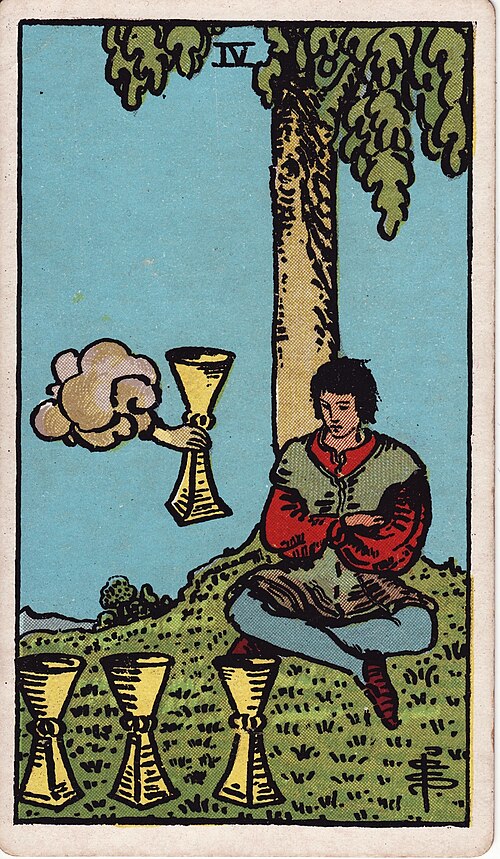
A young figure sits with arms folded, back against a tree, looking down towards three cups lined up on the grass. The body is closed. The gaze is not on the sky. This is a posture of having had enough, or of having gone inward so far the garden has become wallpaper.
From a cloud, a hand offers a fourth cup, the same kind of cloud-hand you met on the Ace. He is not taking it. He may not even see it. Do not decide too fast whether that is ingratitude, protection, depression, or a man who already has three cups and does not need a fourth. The picture allows all of those.
The tree is shade and a spine. He has somewhere to lean. That is not nothing. A figure sitting in a desert would be a different four. This one has chosen, or found, a place to stop.
What is missing is movement, company, and any sign he will uncross his arms. The three cups on the ground are upright. Nothing has spilled. This is not the Five. The water is still available. He is the one who has stopped pouring.
Symbolism
The offered cup is the cousin of the Ace, and that matters. New feeling is still trying to arrive. The difference is the person. In the Ace there was no one to refuse. Here there is someone with a whole body dedicated to not reaching.
Three cups already on the grass. Past offerings, current options, yesterday's toasts. Ask whether they are empty, full, or simply uninteresting to him now. Do not assume they are worthless because he is bored. Boredom is a mood, not a fact about the cups.
Folded arms. A traditional gesture of defence, self-hugging, refusal, holding oneself together. Read the arms with the face. If the face is sour, you have discontent. If the face is far away, you have contemplation. Same arms.
Colour
This picture is quieter than the Three. Olive, grey-blue, a lot of muted ground. The gold of the cups is doing the only bright work, and he is not looking at the brightest of them.
If the dullness of the colour is what you felt first, that is data. The card can feel like a room with the curtains half drawn. Ask whether that dimness is rest or fog.
The offered cup is as gold as the three on the grass. Colour is not marking the fourth as special. The cloud is. If you make the fourth cup magic because you want him to take it, you are writing the story you prefer.
Number
Four. A table with legs. Stability, structure, pause, sometimes a box. In water, four is feeling that has stopped travelling. Contemplation or apathy. The number does not pick for you.
After the social three, four can be the morning after the dance, or the person who never went to the garden. Same number. Different refusal.
Numerology
Four. A table with legs. Stability, structure, pause, sometimes a box. In water, four is feeling that has stopped travelling. Contemplation or apathy. The number does not pick for you.
After the social three, four can be the morning after the dance, or the person who never went to the garden. Same number. Different refusal.
Astrology
Traditionally this is the Moon in Cancer. Moon on moon-home, water on water. That can be deep rest, moodiness, a tide that will not go out, a person living entirely inside their own weather.
If the Moon association helps you name the inwardness, use it. If it just gives you a caption, go back to the folded arms. The picture is clearer than a sign.
Energy
This card is still. Contracted. Seated. The energy is a closed circuit of feeling. Not empty. Held in.
It can feel like a sigh, like fog, like finally sitting down. It can feel like a teenager on a bench who will not come in for dinner. Do not diagnose from across the room. Sit with how closed the posture is, and whether the fourth cup feels kind or like another demand.
Light expression
A true pause. Knowing you do not want the fourth cup. Contemplation that actually looks inward instead of performing gratitude.
Shadow expression
Apathy dressed as discernment. Refusing every cup because feeling would mean moving. Sitting under the tree until the three good cups on the grass are wasted.
Archetype
Three was the garden and the toast. Four sits down. Number plus suit plus image. Four of water, a seated figure under a tree, three cups on the grass, a fourth offered from a cloud, and a body that is not reaching.
Four wants structure. In Cups, structure can be a rest, a rut, a boundary, a sulk, a meditation. The suit of feeling has hit a square. Squares hold. Squares also box.
Intuitive questions
Is he refusing the cup, or has he not seen it yet?
What are the three cups on the grass, in this question?
Is the tree shelter, or a hiding place?
Does this stillness feel like rest or like fog?
What would have to change in his arms before anything else could happen?
Reflection
As advice, sit down, or look up, depending on the question. That is not a contradiction. Context decides whether the gift is the pause or the cup. As a past card, the refusal that started the present. As a future card, a stall unless something uncrosses the arms.
Beside the Ace of Cups, the offered cup is almost certainly that Ace, and the reading becomes about receiving. Beside the Five of Cups, this four can look like the moment before something spills from neglect. In a love reading it can be a partner who has checked out, or a person protecting a tender inside.
Practice
Sit the way he sits. Arms folded, eyes down, for one full minute. Then imagine a cup appearing at your side. Write whether you wanted it. Then look back at the card and describe only the tree, the three cups, and the cloud-hand. Practise separating your sulk from his.