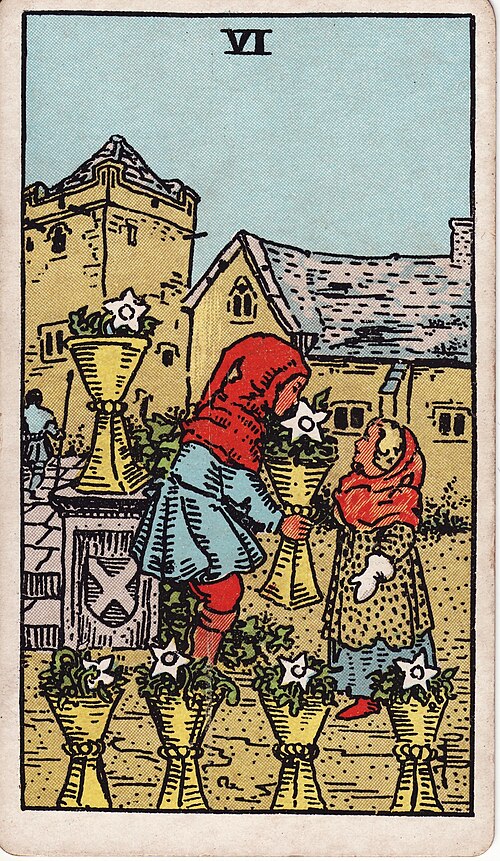
Six of Cups
Six
These are public-domain Rider–Waite–Smith plates, so you can practise looking. They are study images, not the teaching. Sit with the picture first.
Practise this cardOpen the course lessoncups
Six of Cups
Six
This is revision. The course lesson teaches. Sit with the image first. Traditional meaning is the foundation, not the whole reading.
Traditional meaning
Traditionally the Six of Cups is nostalgia, childhood, innocence, memories, gifts from the past, a sweetness returning. Keep that. The traditional note is memory and sweetness, and the picture is built for it.
Traditionally it can also be a reunion, a kind offer, old friends, the inner child language people reach for. Learn those. Then look at who is giving, who is smaller, and whether the flowers are alive. The past is not automatically safe just because the card is pretty.
Visual interpretation
A taller child offers a cup to a smaller one. The cup is filled with a white, five-petalled flower, not wine. Other cups sit around, also flowering. This is giving, and it is happening at a child's height. Look at the size difference. One is in the role of giver. One receives.
The setting is an old town courtyard, stone, a doorway, a guard or older figure walking away in the background. The adults are not in the exchange. Safety, or the idea of it, is walking off in armour. The children have the flowers.
The flowers are fresh in the cups. Not dried, not drawings of memory. Something living is being handed over. Ask whether this is a recollection, a present-day kindness that feels old-fashioned, or a person offering the past as if it were a bloom that never wilted.
There is a lot of yellow air. The scene is lit like a story you tell nicely. That lighting is part of the card. Sweetness can be true. Sweetness can be the filter. Look at the cobbles as well as the petals.
Symbolism
White flowers in cups. Feeling that has been made gentle, almost ceremonial. A cup of wine would be a different six. A cup of bloom is innocence, offering, perhaps a sanitised version of water. Ask what has been left out of the bouquet.
The two children are not peers. Giving and receiving are unequal here. In a reading that can be care. It can be a parentified child. It can be you offering your younger self something. It can be someone handing you a simplified past and asking you to be grateful.
The departing guard is easy to ignore. An older figure, a spear, a walk towards the town. Protection leaving, or protection finally giving the children the courtyard. Missing adults matter in a memory card. Who was not there?
Colour
Yellow takes the air and makes the whole courtyard feel warmed. If that gold-yellow hit you as comfort, stay with comfort. If it hit you as faded photograph, stay with that. Colour is doing memory-work, not just decoration.
The white of the flowers is the cleanest note. It draws the eye to the gift. White here is the sweetness being handed over. Ask whether that white feels honest or bleached.
Stone and the guard's darker clothing keep a little gravity in the background. If you only see the children, you have been seduced by the foreground, which is what this card is very good at.
Number
Six. After a five, something tries to arrange itself. Harmony, reciprocity, a story that makes the disruption bearable. In water, six is memory and sweetness, the offer of a kinder cup.
Six can be genuine care. Six can be the tale we tell so we do not have to stay with the spilled wine. Look at whether the flower is alive in the present, or only in the telling.
Numerology
Six. After a five, something tries to arrange itself. Harmony, reciprocity, a story that makes the disruption bearable. In water, six is memory and sweetness, the offer of a kinder cup.
Six can be genuine care. Six can be the tale we tell so we do not have to stay with the spilled wine. Look at whether the flower is alive in the present, or only in the telling.
Astrology
Traditionally this is the Sun in Scorpio. A strange pairing if you only know sun as happy and Scorpio as dark. Sun in deep water can be warmth taken into the underworld of feeling, childhood in a place that was not only pretty, a light pointed at old rooms.
If that adds a shadow to the courtyard, use it. If it does not, the departing guard and the size of the two children will give you the same complexity without a planet.
Energy
This card is offering. Soft, small-scale, slightly old. The energy moves from a larger child to a smaller one. It is not the Ace's sky-gift and it is not the Two's eye-level pact.
It can feel like relief, like being allowed to be little, like home. It can feel cloying. It can feel like someone handing you a version of then that you did not live. Trust the body. Sweetness should not make you smaller unless you asked to be cared for.
Light expression
A true kindness from the past, or a present offer made with a child's honesty. Memory that nourishes without trapping you in the courtyard.
Shadow expression
Nostalgia as a cage. Giving that keeps someone small. A bleached childhood story. Using the past to avoid the two standing cups of the present.
Archetype
Five was spill and remainder. Six tries to find a way that feels like care. Number plus suit plus image. Six of water: memory, sweetness, a child offering a cup of white flowers to a smaller child in an old town.
After disruption, water looks backward or sideways for something kind. That can heal. That can also trap you in a courtyard that no longer exists. Six is not a guarantee of harmony. It is the attempt.
Intuitive questions
Who is the taller child in this question, and who is smaller?
Are the flowers alive now, or only in a story about then?
What is the guard in the background doing by leaving?
Is this sweetness feeding you, or shrinking you?
What has been left out of this pretty courtyard?
Reflection
In love, an old flame, a sweet beginning, a relationship that keeps returning to then. In family questions this card can be almost literal. In work, a mentor offering something simple, or a company trading on heritage.
As advice, give the flower, or accept it, or leave the courtyard. Beside the Five of Cups, six can be the two remaining cups given a face. Beside the Devil, the sweetness may be a hook. Beside the Eight of Cups, memory is what you are walking away from, and the children make that harder.
Practice
Choose one real memory that this card reminds you of. Write it in two versions. First, the sweet courtyard version with white flowers. Second, the version that includes the guard walking away and the size difference. Then look at the card again. Practise letting memory be water, not a postcard.