Three of Pentacles
Three
These are public-domain Rider–Waite–Smith plates, so you can practise looking. They are study images, not the teaching. Sit with the picture first.
Practise this cardOpen the course lessonpentacles
Three of Pentacles
Three
This is revision. The course lesson teaches. Sit with the image first. Traditional meaning is the foundation, not the whole reading.
Traditional meaning
Traditionally the Three of Pentacles is work, skill, and collaboration. A job done well enough that other people show up to it. Craft meeting a plan meeting a blessing, or a contract.
Old titles call it work, or material works. Traditionally: apprenticeship recognised, a team, building something that will last, competence that can be seen.
It isn't only a career card, though it is often that. Traditionally it is the moment earth becomes a practised skill instead of a lucky coin.
Visual interpretation
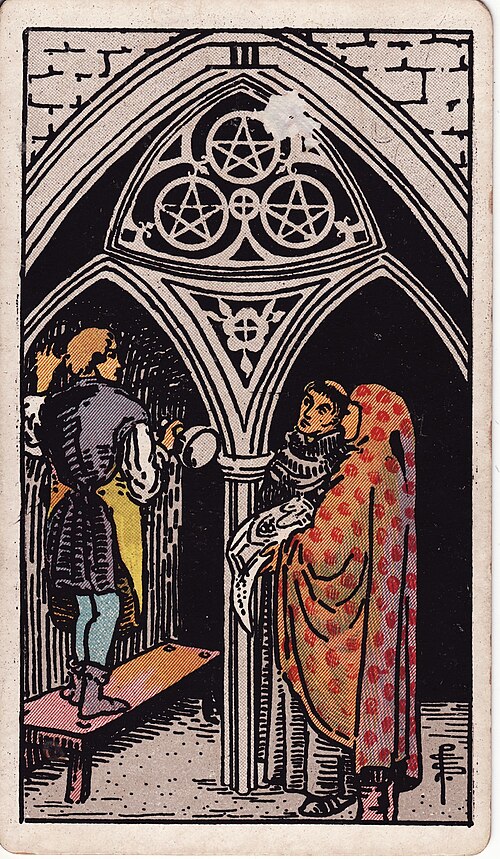
A craftsman stands on a wooden bench, tools in hand, working the stone of a cathedral. He is physically above the other two, which is easy to skip if you're busy calling this a meeting.
Two figures stand below: one in robes, monk or priest, and one in a more worldly coat holding plans. They look up. The work is happening in an arched interior, stone on stone, sacred architecture, not a garden shed.
Above them, three pentacles are built into a carved arch, part of the building, not coins in a pocket. Look at faces if you can see them, at hands, at who is speaking and who is making. The picture is a conversation between skill, design, and meaning.
Symbolism
The cathedral isn't a random backdrop. You're looking at work meant to last, work that belongs to more than one ego. Ask whether this question is about a job, or about building something that will still be standing when you have gone home.
The plans in the second figure's hands matter. Someone has a design. The craftsman has the hands. The robed figure has a tradition or a blessing. Three kinds of knowing. Which one is missing in your situation?
The three pentacles in the arch are the number made into architecture. Skill has become part of the building. That's different from three coins on a table. Why are they in the stone?
Colour
Stone greys and pale golds. The pentacles glow against the arch. Robes pick up warmer colour, a bit of red, a bit of earth brown. It's an indoor card, cooler than the Ace's garden.
Notice whether the gold in the three pentacles feels like pride in the work or like a prize being watched. Colour here is mostly mineral: stone, metal, dust. If it feels warm anyway, that is the human labour doing it.
Number
Three. Skill. A triangle of maker, plan, and purpose. Three takes the pair and gives it a job to do together.
In earth, three is rarely a chat. It's competence that can be shown. Compare the Three of Swords, where three is piercing. Same number, different field. Here three builds.
Numerology
Three. Skill. A triangle of maker, plan, and purpose. Three takes the pair and gives it a job to do together.
In earth, three is rarely a chat. It's competence that can be shown. Compare the Three of Swords, where three is piercing. Same number, different field. Here three builds.
Astrology
Traditionally this card is linked with Mars in Capricorn. Drive applied to structure. Effort that wants a result you can point at.
That can add heat to a card people treat as politely professional. Mars in Capricorn isn't vague inspiration. It's work with elbows. Use the layer if this reading needs that extra. Skip it if the cathedral is already saying enough.
Energy
Focused, collaborative, constructive. Movement in the hands, stillness in the building. The energy is being good at something in public, or at least in front of two other people.
It can feel like pride. It can feel like being assessed. The bench is a stage as well as a workplace.
Growth through practice, not through a speech about potential.
Light expression
Skill is offered, received, and made part of something larger than one person's name. Collaboration with a real division of labour. The work can bear looking at.
Shadow expression
Performing competence, hiding in the team, or refusing to be the one on the bench. Or the opposite: you won't let anyone else near the cathedral because only your hands are good enough.
Archetype
Number three in earth. Three is skill: a third point that turns a juggle into a structure. Earth is craft, work, body, value. This is making, with witnesses.
The Two was keeping things in the air. The Three has a bench, a cathedral, and other people. The Four will try to hold onto what has been built. This card is still in the making.
Number plus suit plus image. Three pentacles set into an arch, a craftsman, two figures with a brief. If you only remember teamwork, you'll miss who is actually holding the tool.
Intuitive questions
Who's on the bench in this situation, and who is holding the plans?
What's actually being built, and will it last longer than the meeting?
Which of the three kinds of knowing is missing: hands, design, or meaning?
Are you collaborating, or performing a collaboration?
Reflection
Career: often the most straightforward, recognition of skill, a team that works. Love: building a life with practical help, or a relationship that needs a third element such as a home, a child, a shared work. Spiritual questions: making devotion with your hands, not only your feelings.
If this lands in the past, it can be training you already have. In the future, a project that will require other people. Beside a Five of Pentacles it can ask whether the cathedral has a door for those in the snow. Beside an Eight of Pentacles it says the apprentice and the recognised maker are neighbours, not strangers.
The question decides whether you're the mason, the planner, or the one in robes. Don't assume you're the hero with the chisel.
Practice
Describe the three figures without using the card's name. Then write which one you're today: the maker, the one with the plans, or the one bringing meaning to the work. Practise this card by doing one hour of actual craft, then asking one other person for a real piece of input, not praise.