Eight of Pentacles
Eight
These are public-domain Rider–Waite–Smith plates, so you can practise looking. They are study images, not the teaching. Sit with the picture first.
Practise this cardOpen the course lessonpentacles
Eight of Pentacles
Eight
This is revision. The course lesson teaches. Sit with the image first. Traditional meaning is the foundation, not the whole reading.
Traditional meaning
Traditionally the Eight of Pentacles is craft, diligence, and the apprentice at the bench. Work as repetition. Skill built by doing the thing again.
Old titles call it prudence. Traditionally: employment, handiwork, commission, training, a person who is actually practising rather than talking about their gift.
Foundation: this is labour with a tool in the hand. Not glamour. Competence on the way to mastery, or mastery that still shows up for the bench.
Visual interpretation
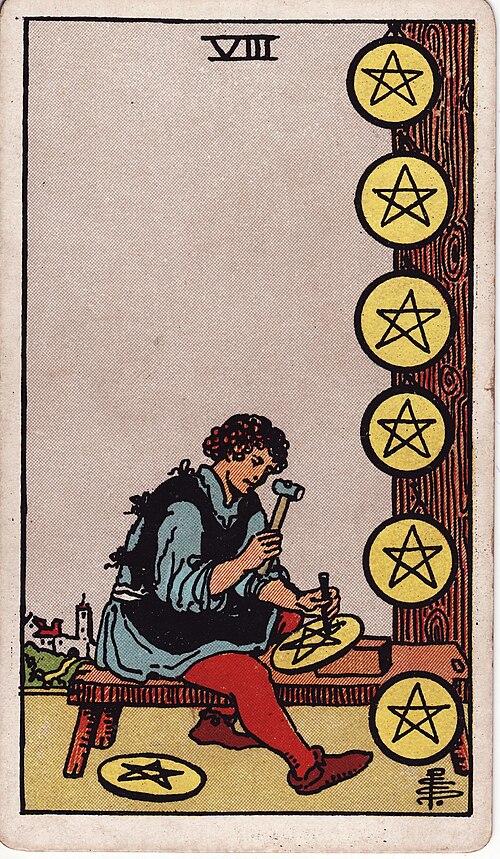
A craftsman sits at a wooden bench, hammer raised over a pentacle he is finishing. Six completed pentacles hang on a timber display to his left. One more rests on the ground. One is under the hammer. Eight, if you count. This is a production, not a one-off.
He wears a work apron. The posture is bent to the task. In the distance, a town or city sits under a pale sky. He isn't in it. He is at the edge, in the workshop of the field, repeating a form until it is true.
Look at the hanging coins as a row of proof. Look at the hammer as the present tense. Look at the city as a maybe. Where did your eye go first: the work, the wall of finished pieces, or the town he isn't visiting?
Symbolism
The bench is dedicated space. Craft needs a place that is for the work. Ask whether this question has a bench, or only a wish for a reputation.
The hanging pentacles are a portfolio. Skill made visible. They can be pride, evidence, or a row of the same mistake perfected. What does repetition look like in your situation: mastery or a rut?
The distant city is other people's life, market, audience, home. Why is it small? Because the card is about the work, not the applause. If you keep staring at the city, you may be using craft as a way to get elsewhere, which is allowed, and it will change the reading.
Colour
Browns of wood and earth, grey-blue distance, gold in every pentacle. A little red in the clothes or the cap in many decks, a spark of heat in the labour.
The gold repeats eight times. That's a lot of the same colour doing the same job. If it feels satisfying, you like the mill. If it feels monotonous, the colour is telling you the shadow of eight: the engine that won't stop. Either way, don't translate gold as success and clock off.
Number
Eight. Craft. Strength through repetition, mastery, a mill. In earth, eight is hours, sets, drafts, the tenth time you cut the joint until it fits.
Eights can feel like flow or like a factory. This one is honest about both. Feel the engine. Then ask if the engine is serving a life, or eating it.
Numerology
Eight. Craft. Strength through repetition, mastery, a mill. In earth, eight is hours, sets, drafts, the tenth time you cut the joint until it fits.
Eights can feel like flow or like a factory. This one is honest about both. Feel the engine. Then ask if the engine is serving a life, or eating it.
Astrology
Traditionally this card is linked with the Sun in Virgo. Identity and vitality meeting a sign that perfects, analyses, and serves through detail.
Sun in Virgo can add pride in the small true thing, and a shadow of never being finished. If this reading is about workmanship, the pairing is almost too neat, which is a reason to still look at the hammer instead of reciting Virgo. Use the layer when discernment and service are actually on the table.
Energy
Repetitive, absorbed, productive. Movement in the arm, stillness in the attention. The energy is practice as a climate.
It can feel satisfying in the bones. It can feel like you have become a pair of hands with no Sunday.
Inward focus, outward product. Not social, unless the finished coins are meant for the city later.
Light expression
You do the work in front of you well, again, and you let skill accrue. Craft as devotion. Progress you can hang on a wall. The city can wait until the piece is true.
Shadow expression
Drudgery without growth, or perfectionism that won't let a piece leave the bench. You hide in labour so you don't have to enter the city, the body, or the rest of your life. The mill owns you.
Archetype
Number eight in earth. Eight is craft: an engine, repetition, a lot of power in a small space. Earth is work, skill, body, value. This is the mill of making.
The Seven looked at the crop. The Eight puts the hands back on the work. The Nine will show a person who can sit in a garden they already grew. Don't skip the hammer and claim the grapes.
Number plus suit plus image. A craftsman, a bench, a hammer, eight coins, a city in the distance. If you only remember hard work, you'll miss that six pieces already hang on the wall and the city isn't where he is looking.
Intuitive questions
What are you actually repeating, and is it making you more skilful or only more tired?
Are you looking at the hammer, the wall of finished work, or the city?
Where is the bench in your week, and do you sit at it?
What would one true piece look like, as opposed to eight hurried ones?
Reflection
Work: the most at-home this card gets. Love: showing care through practical effort, or a relationship that has become unpaid labour. Health: rehab reps, a daily practice, skill in the body. Money: earning by production, not by windfall.
Advice: get to the bench. Challenge: you're already at the bench and calling it a life. Beside the Three, compare apprentice and recognised mason. Beside the Nine, ask when practice becomes enjoyment of the result. Beside the Ten, ask whether you're building a family system or only a wall of coins. A neighbouring Knight of Pentacles will slow you further on purpose. A neighbouring Ace will remind you why you picked up the hammer.
If the querent hates their job, this card isn't automatically a scolding to work harder. Look at the city. Look at the face. Ask whether this is the right craft.
Practice
Practise one small repeated action for ten minutes the way the craftsman hammers: the same cut, the same sentence, the same stretch. Then look at the card and write what skill is actually being built, not what title you want. Hang that sentence where you work.