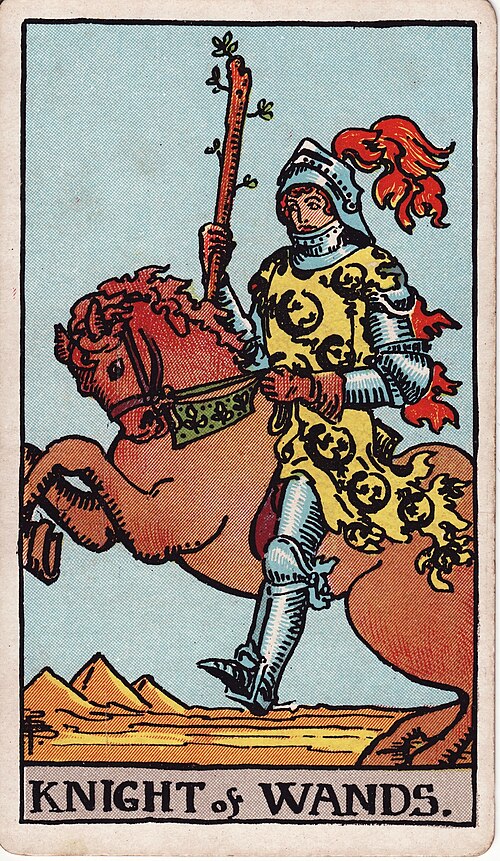
Knight of Wands
Knight
These are public-domain Rider–Waite–Smith plates, so you can practise looking. They are study images, not the teaching. Sit with the picture first.
Practise this cardOpen the course lessonwands
Knight of Wands
Knight
This is revision. The course lesson teaches. Sit with the image first. Traditional meaning is the foundation, not the whole reading.
Traditional meaning
Traditionally the Knight of Wands is a person of fire in motion: departure, travel, a quest, haste, a charming rush of will. Old books talk about a young warrior, a journey in the south, change of residence, a hot-headed ally, adventure arriving on a horse.
Learn that. Then put down the slogan that Knights equal action, as if the other seventy-seven cards were napping. This Knight is a stage of fire: heat that has left the desert study and entered the world at speed. Traditional haste is a foundation. The rearing horse is the lesson.
Visual interpretation
A horse rears, body a diagonal of muscle, facing the left of the card as if the land itself had better get out of the way. The rider is in armour with a yellow surcoat printed with salamanders, a red plume exploding from the helmet, wand held forward and up, not studied, aimed.
Behind them, desert and pyramids, the same climate as the Page but seen at a gallop. No pergola, no town, no crowd with wreaths. Travel country. The horse's face is fierce. The Knight's face is set toward somewhere that is not in the picture yet.
Notice the hooves off the ground. Notice the wand is not sprouting in a quiet way for contemplation; it is a spear of will. Notice how much of the card is animal. Fire at this stage borrows a horse. What hit you first: the plume, the rearing, or the empty desert they are charging into?
Symbolism
A rearing horse is impulse made flesh. Traditional travel and haste live here because the animal is not walking like the Six's parade horse. This is lift, risk, a moment when gravity is optional. Ask whether the horse is bravely aimed or about to throw the rider. The drawing supports both.
Salamanders again, now at speed. Fire-creatures on a charging body. The Knight is not dabbling in the suit. They are wearing it into a fight, a journey, a seduction, a move. Armour says they expect impact. The Page had a tunic. This one came dressed to hit something.
Pyramids in the background: the old world falling behind. Knights leave. That is their job in the climate of fire. If a reading needs someone to stay and do the dishes, this card may be the part that will not, or the advice to go, or the warning that going is the only tool they have.
Colour
Yellow, gold, the horse itself almost the colour of flame, red plume as a streak of extra heat. The desert is paler, a runway. Armour catches light. This is one of the loudest colour cards in the suit.
If the red plume is what you cannot unsee, the display is talking: look at me go. If the horse's belly or hooves catch you, the animal cost is talking: this speed has a body. Gold here can be courage you can feel in the thighs. It can also be a warning that everything has become the same hot colour and there is no cool left to think with.
Number
Knights are the second court stage, if you need a sequence: after discovery, motion. Not a pip. Still, you can feel an eight in them, the engine, and a two in them, because a Knight is always a person plus a horse, a pair in motion.
Do not trap them as 'twelve' or a numerology trick unless that layer is honestly speaking. The teaching is stage, not arithmetic. Fire that has to move to know it is real.
Numerology
Knights are the second court stage, if you need a sequence: after discovery, motion. Not a pip. Still, you can feel an eight in them, the engine, and a two in them, because a Knight is always a person plus a horse, a pair in motion.
Do not trap them as 'twelve' or a numerology trick unless that layer is honestly speaking. The teaching is stage, not arithmetic. Fire that has to move to know it is real.
Astrology
Traditionally some schools call the Knight air of fire: heat that travels as idea, speech, quest, a wind feeding a flame. Others hang Sagittarius on this horse, the archer's distance and appetite. Both are old notes, not homework you must finish in a reading.
Use air-of-fire if the situation is a charged message plus a packed bag. Use a Sagittarian flavour if the hunger is for far, true, more. If you are only pinning a sign on a person to make the court easier, you are back on the personality quiz. Stop.
Energy
Forward, hot, unstable in the best and worst sense. Expansion at a canter that wants to be a gallop. Active. Not receptive unless the horse throws them. You can feel it in the legs and the throat.
Exciting to sit with if you have been the Nine too long. Frightening if you need a Four. The energy is honest: this will not be a still week if this Knight is running the table. Whether that is medicine or a scorch is the rest of the spread's job.
Light expression
Courage that actually leaves the desert. You put the wand forward, you let the horse lift, and you spend heat on a real direction instead of on a speech about someday.
Shadow expression
Scorch marks. Starting the next thing before this one lands. Lust, rage, or ambition with no landing gear. Leaving people in the dust and calling it freedom. Or a life of almost-charging, armour on, horse ready, never quite going, which is the Knight in reverse spirit even if the card is upright in your hands.
Archetype
The Page looked at the wand. The Knight is using it as a direction. Developmental stage of fire: pursuit. The will that books the ticket, says yes before the Two has finished the map, tests what heat can do by doing it. Not 'immature King.' Not 'male energy.' A complete climate of Wands in motion.
Courts can be people of any gender, parts of you, behaviours, a maturity you are growing into, or a shadow you are hiding in. This one is the part that cannot sit. Compare the Eight of Wands, which is speed with no rider. The Knight is speed with a personality attached, for better and for scorch marks.
Intuitive questions
Is this horse aimed at something, or only away from something?
Who gets the dust, if you charge?
Is this a person, a part of you, or a behaviour the question is asking you to try?
What would courage look like that still had a destination?
Reflection
As a person: anyone whose fire is currently a horse, not a throne. Age and gender are not the key. Pace is. As a part of you: the week you cannot sit. As advice: go. As challenge: you are already going and calling it destiny so you do not have to aim.
In love this can be a whirlwind, a hot pursuit, a lover who will not nest, or you in that costume. Surrounding Cups ask if anyone has a heart in the saddle. Surrounding Pentacles ask who pays for the horse.
Beside the Page, sequence: looking, then leaving. Beside the King, a tension between charge and stewardship. Beside the Eight, almost too much speed in one sentence. The table will tell you if this is brave or merely loud.
Practice
Name a charge you are actually in. Stand up while you look at the Knight of Wands, because this card is a bad one to slouch through. Write: what the wand is pointing at, what the pyramids are behind you, and whether the horse is rearing toward a place or only off the ground. Then walk around the block at a pace that feels like this Knight. Come back and write the cost in your body. Traditional haste last.