Course/The Seventy-Eight Cards/Major Arcana, card by card
Part 01
The Fool
Observe first. Interpret second. Research third.
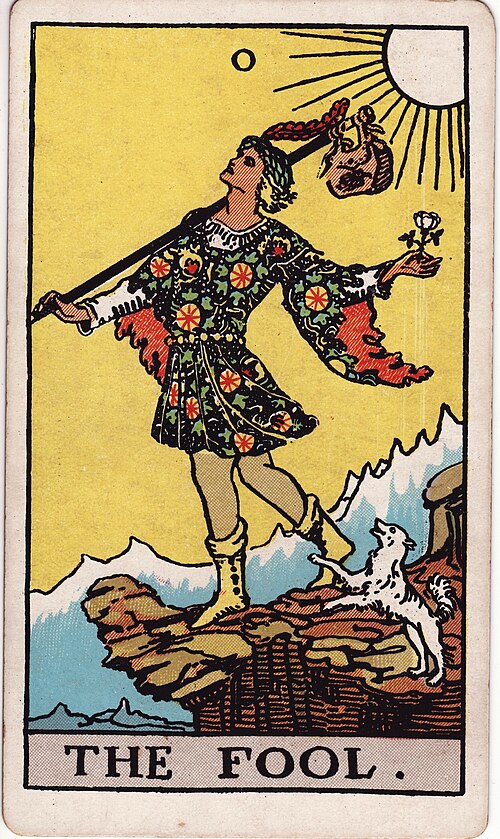
The Fool
Major · 0
Traditional foundation
Traditionally, The Fool is the unnumbered start. In Rider-Waite-Smith teaching this card is newness, trust, a leap, innocence, and the willingness to begin before you have a map. Waite wrote of folly, of the spirit in search of experience, of a wanderer who has not yet been taught to be afraid of the drop.
The little white dog, the cliff, the bindle over the shoulder, the white rose, the sun, the mountains behind: the traditional picture is a young figure stepping toward empty air with their head lifted. The old books call this faith, and they also call it foolishness. Both sit in the traditional reading. A new chapter. A risk that has not been calculated. The kind of beginning that looks like naivety to people who have already fallen once.
That is the foundation. Keep it. Then look. The traditional note will not tell you whether this Fool is blessed, reckless, protected, or about to learn gravity the hard way. The image, the question, and the cards around it will.
Where it sits in the deck
Zero sits before one. The Fool is not card one of twenty-two. It is the open space the rest of the sequence walks into. After The World, plenty of readers put The Fool back on the path. Notice that this card has no predecessor in the line, and that The Magician is waiting just ahead with tools already laid out.
Numbered nothing is not empty. Zero is the pause before a first move, the uncommitted step, the person who has not yet chosen a title. Sit The Fool next to The Magician and you can feel the difference. One is looking up with a bindle and a dog. The other is standing at a table pointing at heaven and earth.
Look at this image
Cover the keywords. Look at the cliff. Is the front foot already over the edge, or still on stone? Look at the little dog. Is it warning, playing, herding, celebrating? You do not get to decide that from a poster. You get it from this picture and this question.
The figure is looking up, not down. Why? The sun is out. The mountains are behind, not in front. The bindle is small. The rose is white and held, not worn. Ask why a traveller would carry so little and still hold a flower. Ask what they are refusing to look at by staring at the sky.
Where does your eye land first? Cliff, dog, sun, face, rose? That first landing is data. Stay a full minute before you let the word leap into the room.
Symbols worth investigating
The white rose is not automatically purity. In this picture it is being carried toward a drop. Is it an offering, a refusal of the world's dirt, a souvenir from a garden they have already left?
The bindle is a whole life reduced to a stick and a cloth. That can be freedom. It can be under-preparation. The little dog is the only other creature on the card. Notice whether it feels like company, conscience, or a last chance to turn around.
Colour in this card
The sky is a clear yellow, almost a stage light. This is not a storm-leaving card. The white of the rose and the dog sit against that brightness. If the yellow feels like joy in this question, say so. If it feels like glare, like they cannot see the cliff because the day is too bright, say that instead.
Number
Zero is the space something can start in. It is also the number that will not commit to a rank. Do not caption zero as destiny. Feel whether this nothing is fertile, or whether it is a refusal to become one of anything.
An astrological layer
In the usual Golden Dawn and Rider-Waite-Smith correspondence this card is Air and Uranus. Air as the unboxed breath. Uranus as the sudden, the unconventional, the jolt that will not stay in the old shape. Use it if this Fool actually feels like a shock of freedom. If it is simple innocence, leave the planet in the notebook.
What is this card doing?
This card is moving. Not marching. Stepping. The energy is forward and slightly off-balance, head up, weight already shifting toward air. It is expansion without a container yet.
Light and shadow
Light. Trust enough to begin without the whole map. A clean first step, taken with the body in it, not as a performance of being fearless.
Shadow. Looking up so you never have to look down. Recklessness dressed as freedom, or a habit of starting so you never have to become anyone in particular.
How this can show up
In self-work this often arrives as the chapter that has not got a job title yet. The move, the course, the conversation you have not had because you cannot yet explain it at a dinner table.
In work it can be the new role, the untested idea, the person hired for potential rather than proof. In love it can be the first yes, or the refusal to look at what the last beginning cost. Do not force romance onto this card.
Same card, different reading
As advice, The Fool can be go. As a warning, it can be look down. As a past position, it can be the leap already taken. The question writes the verb.
If The Fool sits next to The Devil, that leap may be an escape dressed as freedom. If it sits next to The Star, the same step may be the cleanest thing on the table. Read the conversation, not the caption.
Activity
Describe before you interpret
Cover the traditional notes above. Look at the image. Write only what you see. People, objects, weather, direction, colour, what is missing. No meaning yet.
Activity
Ask the card
Where is the cliff in this question, and has anyone actually looked at it? What is the little dog doing: warning, playing, or being ignored? Why is the face turned up, and what is not being looked at? Is this a beginning, or a refusal to finish the last thing? What would change if this Fool looked down for one second?
Practice
Practise this card
Open The Fool in the Practice Room. Cover the traditional notes. Write only the cliff, the dog, the rose, the bag, the sun. Then uncover the notes and write what matches, and what the picture is doing that the caption is not. Do not decide yet whether this leap is wise.
Open the practice