Course/The Seventy-Eight Cards/Major Arcana, card by card
Part 11
Wheel of Fortune
Observe first. Interpret second. Research third.
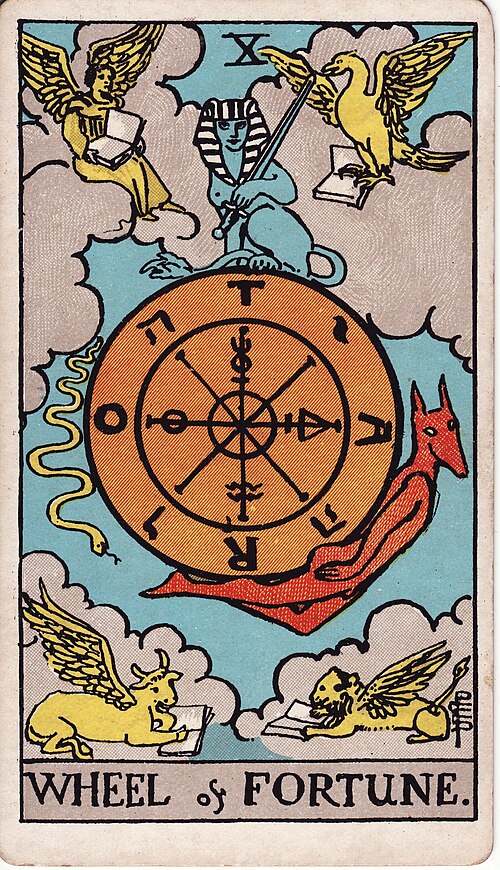
Wheel of Fortune
Major · X
Traditional foundation
Traditionally, the Wheel of Fortune is change, luck, the turn you do not get to chair. In Rider-Waite-Smith teaching this is destiny as a moving thing, cycles, a reversal of position, the reminder that no seat on the wheel is permanent. Waite filled the card with creatures and letters rather than a simple carnival wheel, because the old idea is bigger than a lucky day.
A sphinx sits on top with a sword. A serpent descends one side. Anubis, or a rising jackal-figure, comes up the other. Hebrew letters and the alchemical TORA, ROTA, TAROT cycle round the wheel. Four living creatures sit on clouds in the corners, books open. Rising and falling are the job of the whole picture. The traditional reading is: something is turning. You are on it. Act accordingly.
Keep that. Then look. Traditional Wheel can be a break, a promotion, a season ending, a plot twist. It can also be passivity dressed as spirituality, or a person who will not take the next right action because fate is a better excuse. The rising figure and the falling snake will tell you more than the word luck.
Where it sits in the deck
Ten is a cycle completing, or a load that has got too heavy, or a harvest. After The Hermit's private lamp, the Wheel is the world turning whether you came down the mountain or not. Number ten here is the first of the Majors to feel like a system rather than a person. There is no human hero in the middle. That is the point.
Justice is next. Chance, then consequence. Feel that neighbour. The Wheel turns. Justice weighs. If you collapse them both into what will happen, you will miss the difference between a cycle you are in and a law you are under. Ten hands you motion. Eleven will hand you a sword and scales.
Look at this image
There is no querent-figure standing on a cliff or a throne. Look at that absence. Who are you in this picture: the sphinx, the snake, Anubis, a corner creature, the wheel itself? Cover the title. Describe the machine before you say fortune.
The sphinx is still, on top, with a sword. Why a riddle-beast in the seat of control? The snake is going down. The jackal-figure is coming up. Hebrew and Latin letters sit on the wheel as if language itself were turning. The four creatures in the clouds have wings and books. They are not spinning. They are watching.
Ask what is actually moving, and what only looks busy. The clouds suggest this is not a cart on a road. It is weather and law and story at once. Where does your eye land first: the centre, the falling snake, the top, a corner? That landing is your entry into the turn.
Symbols worth investigating
The four living creatures are the same corner-beings you will meet again on The World: bull, lion, eagle, human. Here they have books. There they will have clouds without the study. Investigate whether this Wheel is a lesson being read, or a spectacle being endured. The letters cycling TORA and ROTA are wheel, tarot, law, the joke that the deck is a rotating teaching. Do not get clever with it unless it is speaking. Sometimes a letter is just the old designers showing their homework.
Sphinx with a sword is knowledge that can cut. Anubis rising is the psychopomp, the one who walks with the dead, coming up. The snake descending is often read as the life-force going into matter, or as a fall. Ask which motion is this question: ascent, descent, or the still point the sphinx is pretending to be.
Colour in this card
Blue sky, gold wheel, red and yellow on the sphinx and the figures, the green of the snake. This is a bright machine, not a grim one. The gold is doing the value of the turn, the sense that something precious is in motion. The blue is the space it turns in, larger than any one life. If the brightness feels like luck, say so. If it feels like a carnival you cannot get off, say that. Colour here is the mood of the sky the wheel is hung in.
Number
Ten as a cycle's harvest and as a one-with-a-zero, a new beginning that is carrying a whole decade of what came before. In this card the ten is the turn itself: completion that immediately starts again. Do not caption ten as the end. Feel whether this ten is a ripe change, or a load of history being spun so fast it looks like destiny.
An astrological layer
Jupiter is the usual correspondence. Jupiter as expansion, fortune, the bigger weather, the teacher, the luck that is also a philosophy.
That can deepen a reading about growth that is larger than effort, about a season of yes, about meaning arriving as a shift in scale. Jupiter can also inflate. If the Wheel on the table is a small practical change and Jupiter would only be a fancy word for lucky, leave it. Use it when the turn actually feels like weather, not like a mood.
What is this card doing?
Turning. Expanding and contracting in the same object. This is motion you participate in and do not own. The energy is cyclic, impersonal, and oddly cheerful in the gold and the wings.
Feel whether you are riding, watching, clinging, or being thrown. Wheel energy can unstick a life that had frozen on The Hermit's peak. It can also be the refusal to get off a ride that is making everyone sick.
Light and shadow
Light. Consenting to a turn that is actually due. Flexibility, timing, the humility of not being the axle.
Shadow. Fatalism, gambling, or inflating every wobble into destiny. Clinging to the top, or identifying with the fall so you never have to steer again.
How this can show up
Work: seasons, markets, a promotion that is also a spin, the job that arrived because the wheel turned, not because you manifested a vision board. Self-work: the pattern you are in, the family cycle, the way your luck stories keep you from the next honest action.
Love can be a meeting that feels fated, a relationship entering a new season, or two people blaming the cosmos for a choice. Ask who is rising, who is falling, and who is the sphinx with the sword, sitting still on top of other people's motion.
Same card, different reading
As a future, the Wheel often says change is coming that you will not fully author. As advice, work with the turn, do not pretend you are the weather. As a past, the spin already happened; look at where you landed. As a person, someone whose presence changes the odds, for better or worse.
After The Hermit, the private lamp meets the public cycle. Before Justice, motion will be asked to account for itself. Next to The Tower, a turn can become a crash. Next to The Sun, a turn can become a clear day. Concrete example: Wheel in the advice position of a stuck job spread, sitting next to the Two of Wands, is not wait for a miracle. It is the world is already moving. Pick a direction of travel instead of narrating fate.
Activity
Describe before you interpret
Cover the traditional notes above. Look at the image. Write only what you see. People, objects, weather, direction, colour, what is missing. No meaning yet.
Activity
Ask the card
Where am I on this wheel: rising, falling, sitting as the sphinx, or watching from a cloud? What is actually turning in this question, and what only looks like motion? Why is there no human hero in the middle of this card? What cycle is completing, and what is it already starting again? If luck is a story I tell, what action sits underneath it?
Practice
Practise this card
Open the Wheel in the Practice Room. Name every figure: sphinx, snake, rising beast, four corner creatures. Assign each one a role in a current cycle of yours. Then write which role you have been playing as if it were the whole card. Looking first. Caption last.
Open the practice