Course/The Seventy-Eight Cards/Major Arcana, card by card
Part 12
Justice
Observe first. Interpret second. Research third.
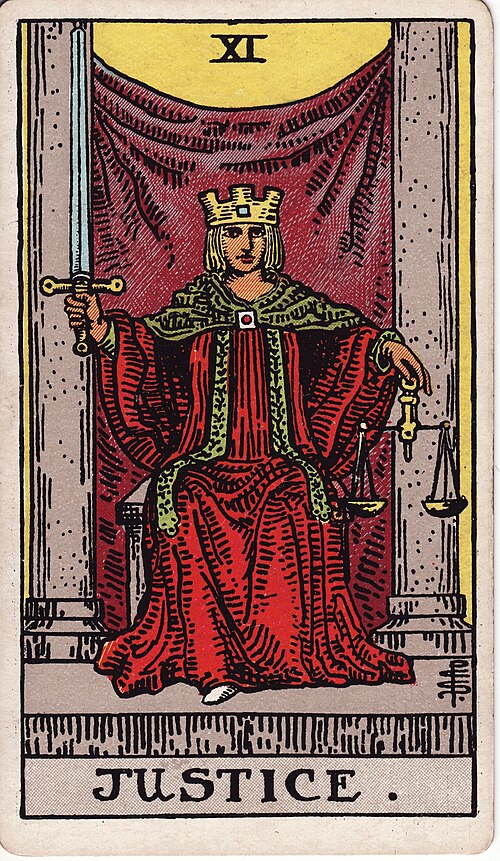
Justice
Major · XI
Traditional foundation
Traditionally, Justice is truth, fairness, cause and effect, the decision that can look at itself in the morning. In Rider-Waite-Smith teaching this is the law of consequence, not only a courtroom. Waite seated her as a virtue: sword and scales, a crown, a gaze that does not flinch. In this deck she is eleven, after the Wheel, before the Hanged Man.
She holds an upright sword in the right hand and scales in the left. Purple sits in the drapery and the cloth. A stone setting, a veil or tapestry behind, a seated frontal pose, a crown. The traditional reading is: weigh it. Cut what is not true. Take responsibility for what you set in motion. The universe, or the culture, or your own spine, will.
Keep that. Then look. Traditional Justice can be a legal matter, a moral reckoning, a clean decision, a restoration of balance. It can also be coldness, self-righteousness, or a person using fairness as a blade. The sword and the scales are both in the picture. Ask which one is doing the work in this question.
Where it sits in the deck
Eleven sits between the Wheel's impersonal turn and The Hanged Man's surrender. After luck, accountability. Before inversion, a still, upright measure. Number eleven is a double one, two pillars of will facing you as a single office. It is also, if you reduce it, a two: the scales.
Do not get lost in the arithmetic. Feel the neighbours. The Wheel said you are on a moving thing. Justice says movement has consequences. The Hanged Man will say some truths only arrive when you stop winning. If you only read Justice as the universe is fair, you will be lying to people. The card is a practice of weighing, not a promise that the world already did it for you.
Look at this image
She is facing you, seated, unlike Strength who looked at the lion and The Hermit who looked at his feet. This one will not let you off the eye-line. Look at the sword. It is up, double-edged, a little high. Look at the scales. They are hanging, not being adjusted in the moment. Are they level in this printing? Look before you assume balance.
The crown is small and firm. The veil behind her is a patterned cloth, not The High Priestess's pomegranates in the same way, though you may see the echo. Why a barrier behind a woman whose job is to see? The stone architecture is square. This is a hall, not a garden.
One foot shows, pointing. Notice the red of the robe under the green, the gold of the crown and the scales. Ask why the sword-hand is the active one and the scale-hand is the receiving one. Ask what she would do if she stood up.
Symbols worth investigating
Sword and scales together are cut and weigh. Investigate which your question needs. A sword without scales is a verdict with no measurement. Scales without a sword are endless maybe. The crown is authority to decide, not only the wish to be right.
The veil behind her can be the idea that truth has a backstage, that not everything belongs in the judgement hall. It can also be the curtain a system hangs so you cannot see how the law was made. Ask which. The square of the stone is the four of structure returning after the Wheel's circle. A different geometry for a different job.
Colour in this card
Purple is doing the office of the virtue: not quite priest, not quite king, the colour of a function that claims to be above the squabble. Red in the robe is the blood of actual consequence. Gold is the metal of the scales and the crown, value made measurable. If the purple feels like dignity, keep it. If it feels like pomp hiding a blunt sword, keep that. Colour here is the climate of a hall where someone is about to speak truly.
Number
Eleven as a threshold number, a one beside a one: the self facing the self. In this card that is the eye-contact. It can feel like a higher octave of The Magician's will, now applied to truth rather than tools. If you reduce eleven to two, you land on the scales, the pair, the requirement to hold two sides. Use the reduction only if it adds. The picture already has two instruments. You do not need a party trick.
An astrological layer
Libra is the usual correspondence, and the scales are already in her hand. Libra as the weighing, the relational justice, the wish for harmony, the gift of seeing more than one side, the stalling that can come with that gift.
That can deepen a reading about partnership contracts, about a decision that will affect the balance of a we, about beauty as a kind of fairness. If Libra would only be she likes peace, skip it. Use it when the card is actually about the cost of imbalance, and the temptation to keep the scales pretty instead of true.
What is this card doing?
Still, upright, cutting. This is not the Wheel's spin. It is a pause that has a blade in it. The energy is poised: one hand receiving information, one hand ready to sever.
Feel whether the poise is integrity or paralysis. Justice energy can clear a fog that was making everyone slightly sick. It can also become a tribunal in the head that never adjourns.
Light and shadow
Light. A clean weighing and a clean cut. Responsibility taken without drama. Truth spoken at a human volume.
Shadow. Verdict without compassion, or endless weighing so you never have to use the sword. Being right as a personality. Fairness used as a weapon.
How this can show up
Work: contracts, appraisals, the decision you have been circling, a legal or ethical knot. Self-work: the stories you tell about who is to blame, the spine it takes to admit your own hand on the Wheel. This card is often the adult in a reading that has been living on hope and atmosphere.
Love can be the conversation about fairness, labour, honesty, the terms. It can be a necessary ending that is just, not cruel. Do not romanticise it into a courtroom TV plot. Ask what is being weighed, and whether both people have access to the scales.
Same card, different reading
As advice, Justice is tell the truth and take the consequence. As a situation, a decision is already on the table, or a law, inner or outer, is in play. As a person, the judge, the mediator, the friend who will not collude. As a past, the cause of which the present is the effect.
After the Wheel, the turn is asked to account for itself. Before The Hanged Man, some questions cannot be solved by a better verdict; they need a different angle. Next to the Two of Swords, compare the blades: one woman is blindfolded and crossed, this one is seeing and raised. Concrete example: Justice in the crossing position of a should-I-stay spread, next to the Three of Cups, is not they were unfair at the party. It is you already know the terms, and the fun is being used to delay the sword.
Activity
Describe before you interpret
Cover the traditional notes above. Look at the image. Write only what you see. People, objects, weather, direction, colour, what is missing. No meaning yet.
Activity
Ask the card
Which is this question asking for: the sword, the scales, or both? What am I refusing to weigh because I already like my verdict? Who put this crown on, and do they still deserve it? If I looked this card in the eye, what would I have to admit? What consequence is already in motion from a cause I keep calling bad luck?
Practice
Practise this card
Look at Justice. Draw a quick pair of scales on paper. On one pan write the truth you prefer. On the other write the truth the image would not let you skip: sword, seat, veil, stare. Sit with the imbalance if there is one. Practice Room for the picture. No summing-up speech until both pans have actual words on them.
Open the practice