Course/The Seventy-Eight Cards/Major Arcana, card by card
Part 20
The Sun
Observe first. Interpret second. Research third.
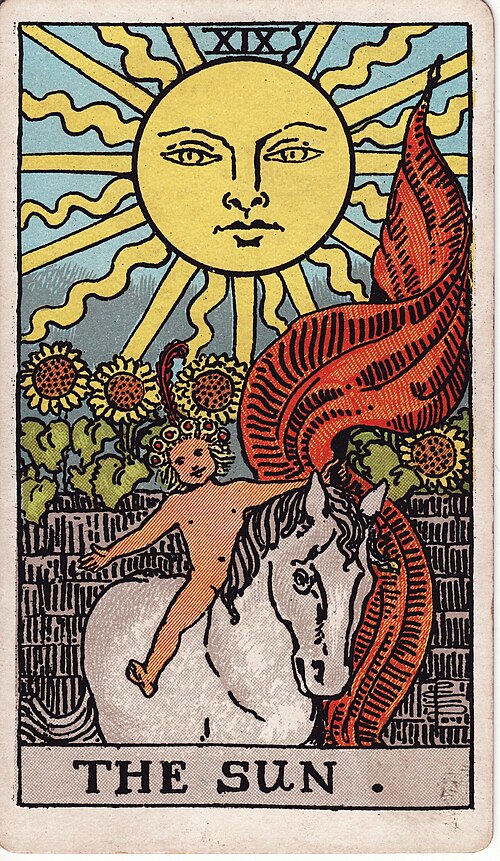
The Sun
Major · XIX
Traditional foundation
Traditionally, The Sun is joy, clarity, vitality, the life that does not have to sneak. In Rider-Waite-Smith teaching this is success, innocence returned with knowledge, the child of the self out in the open. Waite's Sun is a naked child on a white horse, a red banner, sunflowers, a wall, and a sun with a face that is actually smiling.
The child rides, not sits on a throne. The banner is plain red, unblazoned. Four sunflowers look over a garden wall. The traditional reading is: it is day. You can see. Warmth is allowed. After The Moon's howl, this is the road in colour. The old books are almost straightforward here. They still will not tell you whether this sun is a true noon or a performance of fine.
Keep that. Then look. Traditional Sun can be health, recognition, a happy outcome, a creative peak. It can also be glare, naivety, a family photograph that leaves someone outside the wall. The child, the horse, and the wall will tell you more than the word happiness.
Where it sits in the deck
Nineteen sits after The Moon and before Judgement. After the fog, daylight. Before the call from the sky, a life that is simply alive. Number nineteen reduces to ten, the Wheel's number: a cycle in the light. It also sits as one-and-nine, will and culmination, a Magician-Hermit marriage if you need that. Use the arithmetic only if it adds.
Judgement is next. Feel the neighbour. The Sun is the child on the horse. Judgement is the dead getting up when a trumpet says so. Joy, then a calling. If you only read The Sun as the happy ending, you will be startled by people rising from graves in the next picture. The sequence is not a holiday brochure. It is day, then reckoning, then The World.
Look at this image
Look at the child. Naked, crowned with a small wreath, looking back or aside on many printings, not always at you. Why a child, not an adult hero? Look at the white horse, small, almost a pony, unarmoured, no chariot, no skeleton rider. This is not Death's horse and not The Chariot's sphinxes. A living animal in daylight, being ridden without a saddle on many versions.
The red banner is huge for such a small rider. Why so much flag? The sunflowers are behind a wall, looking over. Are they trapped, tended, witnesses? The wall is stone, low enough to see over, high enough to be a boundary. Ask what the garden is for, and why the child is outside it, or in front of it, on a horse.
The sun itself has a face. Straight rays and wavy rays. It is looking. Compare that face to The Moon's. One was half. This is full. Stay with the heat of the image before you write joy. Heat can bless. Heat can scorch. The picture is very bright. Bright is a fact, not yet a verdict.
Symbols worth investigating
A child on a white horse is innocence that can move, not innocence that never left the garden. Investigate whether this is a true return to ease, or a regression, a person refusing adult weather. The smallness of the rider against the size of the sun and the flag is data.
Sunflowers turn to the sun. Here they are also behind a wall. Ask who planted them, and whether the child is allowed back in. The red banner is life-blood as a standard, a yes you can see from a distance. The wall is the last of the towers-and-keeps, shrunk to a garden fence. Civilisation as a low stone, not The Tower's keep. What is being kept in, or out?
Colour in this card
Yellow everywhere, orange in the sun, the red of the banner, the blue of the wall on many printings, white horse, white child. This is the loudest gold in the deck. The yellow is doing vitality, and it is doing exposure. If it feels like a clean noon, keep it. If it feels like a spotlight you cannot get off, keep that. The red banner is the only heavy colour in the ride: blood, joy, a flag. Colour here is climate as weather you can feel on skin.
Number
Nineteen as a ten, a cycle in daylight, and as the last of the teens. In this card the number is the quality of a fullness that has become simple. Not The Moon's almost. A done-ness that can play. Feel whether this nineteen is genuine ease, or a forced brightness that skipped the crayfish and the graves still waiting in Judgement.
An astrological layer
The Sun as the correspondence is almost too on the nose, which is why you have to use it as a quality, not a sticker. The Sun as the centre, the heart of a chart, the life-force, the need to exist in the open, the warmth that makes other things grow, the ego in the old non-insult sense: the I that can say I am.
That can deepen a reading about vitality, purpose, being seen. It can also flag a glare of self. If solar language would only repeat the card's title, you do not need it. Use it when the question is actually about the centre of a life, and whether that centre warms a garden or burns it.
What is this card doing?
Radiating, riding, open. This is expansion without The Fool's cliff and without The Empress's cushions. The energy is outward, warm, simple movement in light.
Feel whether the radiance is shared. Sun energy can heal a Moon-sick room. It can also be the person who brings weather so strong nobody else gets a sky.
Light and shadow
Light. Clean vitality. Joy with a body in it. Clarity that does not require a trumpet. A child of the self allowed out in the day.
Shadow. Glare. Compulsory positivity. Innocence as a refusal to know. A wall that keeps the sunflowers in a private garden while the child performs freedom on a horse.
How this can show up
Self-work: the return of appetite for being alive, health, creative noon, the right to be seen. Work: success, a launch in daylight, recognition, a simple yes. Do not promise fame. Look at the size of the child and the size of the sun.
Love can be warmth, play, a relationship that can go outside, fertility in the wide sense. It can be a couple who only exist as a photograph in front of a wall. Ask who is on the horse, and who is behind the stone with the sunflowers.
Same card, different reading
As outcome, The Sun is often as close as the deck gets to a clean yes, and you still have to look at the wall. As advice, come into the day, tell the simple truth, let the body be glad. As a person, the bright one, the child, the leader who warms. As a shadow position, too much light.
After The Moon, the path has arrived at noon. Before Judgement, enjoy the horse, then listen for the trumpet. Next to The Fool, two suns: one over a cliff, one over a garden wall. Next to The Tower, a keep versus a low wall. Concrete example: Sun in the present of a grief spread, next to the Five of Cups, is not you should be over it. It is there is still a garden and a horse. The spilled cups are real. So is the day. Hold both.
Activity
Describe before you interpret
Cover the traditional notes above. Look at the image. Write only what you see. People, objects, weather, direction, colour, what is missing. No meaning yet.
Activity
Ask the card
Why a child, in this question, and not an adult on the horse? What is the wall keeping in, or out? Is this brightness warmth, or glare? What is the red banner announcing that a quieter joy would not need to? Who is not in the picture, still in The Moon, or already in Judgement?
Practice
Practise this card
Look at The Sun. Write three lists: what the child is doing, what the horse is doing, what the wall is doing. Then stand near a window if you can and notice actual daylight on your hands. Write whether your question is in that kind of light, or whether you have been using the word joy for a spotlight. Practice Room for the image. The window for the weather.
Open the practice