Course/The Seventy-Eight Cards/Major Arcana, card by card
Part 21
Judgement
Observe first. Interpret second. Research third.
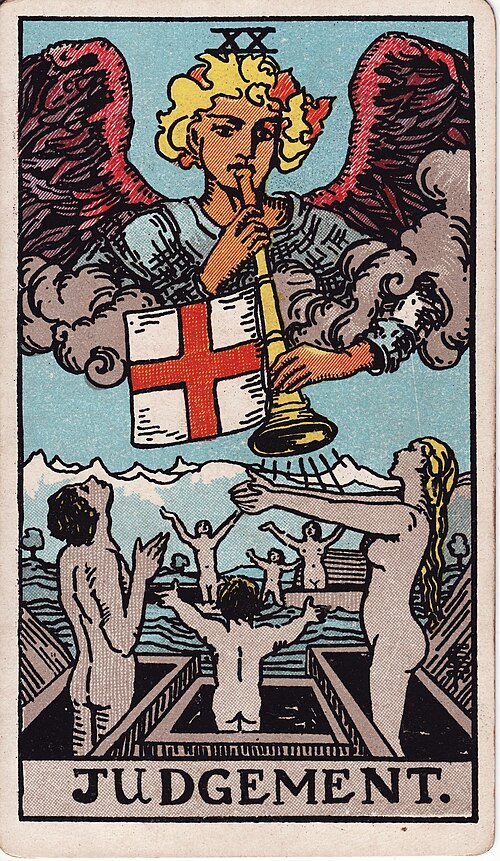
Judgement
Major · XX
Traditional foundation
Traditionally, Judgement is awakening, a calling, the reckoning that is also a resurrection. In Rider-Waite-Smith teaching this is evaluation, forgiveness, the moment you hear a sound that is not your own thought and you get up. Waite's Judgement is an angel in the sky with a trumpet, and people rising from boxes of earth and water.
The angel is huge, red wings, a blue banner with a cross on the horn's flag. Below, a man, a woman, and a child, grey as newly-woken, arms lifted, graves open. Water, mountains in the distance. The traditional reading is: something in you is being asked to rise. The old life will not do. This is not Death's horse. The dead are answering.
Keep that. Then look. Traditional Judgement can be a vocation, a reunion, a verdict you pass on your own past, a second chance. It can also be a inner critic with a trumpet, religious terror, or a person waiting to be called so they never have to choose. The graves and the child between the adults will tell you which.
Where it sits in the deck
Twenty is a double ten, a cycle of cycles, and it reduces to two: the pair, the listening. After The Sun's private noon, Judgement is a sky that interrupts. Number twenty here is completion that still has a job: get up. The World is next, and will not make sense if nobody answers this horn.
The World is the neighbour that completes. Feel that. Judgement is the call. The World is the dance in the wreath. If you only read Judgement as being judged, you will miss the rising. If you only read it as a spiritual glow-up, you will miss the graves. The sequence puts a trumpet between a child on a horse and a dancer in an oval of leaves. Hear why.
Look at this image
Look at who is rising. Three figures, a family of a kind, the child in the middle. Why a child in a resurrection scene? Look at the graves. They are boxes, coffins, tombs in water. Not Death's river-bank with a king. These people have somewhere they are getting up from.
The angel is in the cloud, hair as sun, the trumpet angled toward the earth. The flag on the horn is a red cross on white in many printings. Why a banner on a sound? The mountains are far, blue, a world after this waking. The water is in the foreground. Ask whether this rising is from earth, from feeling, or from both.
Arms are lifted. Faces are lifted. This is the opposite of The Hanged Man's downward head, and of The Hermit's downward gaze. Everyone is answering up. Notice you, the reader, are not being stared at like Justice. You are watching a sky-event. Where does your eye go: angel, child, tombs, mountains? That is who is being called in this question.
Symbols worth investigating
A trumpet is a sound that does not discuss. Investigate whether this call is vocation, conscience, a piece of news, a body getting well enough to stand. Do not file trumpet as the end of the world every time. In this picture it is specifically waking people who were in boxes.
The child between the man and the woman is a third thing being born from a pair, a life that includes both. The flag on the horn is a sign that the sound has a loyalty. Ask to what. The mountains are the same far weather you have seen since The Fool, now as a world you could actually walk into once you are up. Graves in water: the past was a pool as well as a box. The Moon's pool, perhaps, now left.
Colour in this card
Blue sky and mountains, the grey of the risen, gold of the angel's hair and trumpet, red wings and cross. The grey is doing the not-yet-flushed, the newly awake, the colour of a body that has been underground. The gold is the call. The red is the urgency in the wings. If the blue feels like a clean heaven, keep it. If it feels like cold, a summons you did not want, keep that. Colour here is climate of a morning that is also a verdict.
Number
Twenty as a double harvest, a ten made twice, and as a two: listening, answering. In this card the number is the quality of a completion that still requires a response. You can be finished with a grave and still have to stand. Feel whether this twenty is a true waking, or a second round of the same cycle with a louder horn.
An astrological layer
Pluto and Fire are the common correspondences, depending on the school. Pluto as the underworld-and-back, the stripping, the collective grave, the power of what returns. Fire as the angel's element, the horn, the quickening.
That can deepen a reading about a deep rising, about a family pattern standing up, about a calling that feels fated because it is bigger than mood. If Pluto would only be intense as a pose, skip it. Use it when people are actually getting out of boxes, not when someone wants a dramatic caption for a mood.
What is this card doing?
Rising, sounding, collective. This is not The Sun's single child and not The World's single dancer. The energy is a vertical pull, many bodies, one sky.
Feel whether the pull is liberation or conscription. Judgement energy can wake a life that had settled for the box. It can also be a trumpet in the head that never stops, a reckoning with no Sabbath.
Light and shadow
Light. Answering a true call. Rising with others. Forgiveness as a standing-up, not as a speech. The past left in the box.
Shadow. A critic with a horn. Waiting to be summoned so you never have to get up on your own. Shame dressed as awakening, or a resurrection performance for an audience of graves.
How this can show up
Self-work: the calling, the sober look at a life, recovery in the sense of getting up, the family story standing in the water with you. Work: a vocation, a review, a second career, the moment you cannot pretend the job is the grave you agreed to.
Love can be a reunion, a couple waking at the same time, a family system changing. It can be an ex at the door with a trumpet. Ask whether the child in the middle is a new life, an inner child, or a third person. Do not make it automatically a baby. Look.
Same card, different reading
As advice, Judgement is get up, answer, let the old box be old. As a situation, a calling or a reckoning is already sounding. As a person, the messenger, the one who woke first, the judge in the better sense. As a past, you already rose; the question is whether you sat back down.
After The Sun, joy is asked to mean something. Before The World, the rising is not yet the dance. Next to Death, two cards of ending-and-after: one is a horse through a scene, this one is a sky over people who can still move. Concrete example: Judgement in the advice position of a family spread, next to the Ten of Cups, is not your house is blessed, ignore the graves. It is something under the rainbow has to stand up and be heard, or the cups are a photograph on a tomb.
Activity
Describe before you interpret
Cover the traditional notes above. Look at the image. Write only what you see. People, objects, weather, direction, colour, what is missing. No meaning yet.
Activity
Ask the card
What is the trumpet in this question, and have I been pretending I cannot hear it? Which box am I rising from: earth, water, a job, a name? Why is there a child between the two adults? Is this awakening, or a critic with wings? What would I have to leave in the grave to stand?
Practice
Practise this card
Look at Judgement in the Practice Room. Cover the angel. Write only about the three who are rising and the boxes they are leaving. Then uncover the sky and write what the sound is, in your question, in ordinary words: a phone, a conscience, a diagnosis, a yes. No church language unless the picture and your life both use it. Then write one action that would count as standing up.
Open the practice