Course/The Seventy-Eight Cards/Swords
Part 10
Ten of Swords
Observe first. Interpret second. Research third.
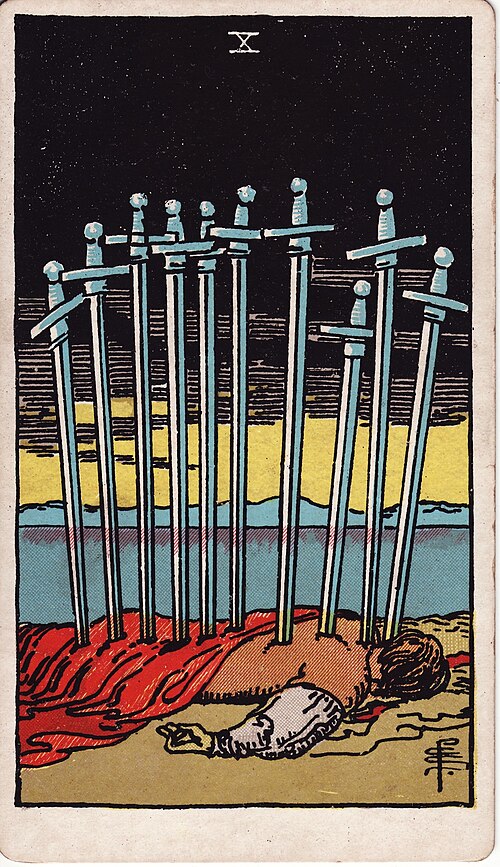
Ten of Swords
Ten
Traditional foundation
Traditional meaning for the Ten of Swords is ending, ruin, betrayal, hitting the floor, the worst of the mind. Collapse. A story over. Sometimes a dramatic victim. Sometimes rock bottom.
Keep it. I am not going to pretend the figure face down with ten swords in the back is a spa day. Traditional disaster is on the card. Then look at the rest of the picture, because the painter put a dawn there, and if you only teach ruin you have not finished looking.
Where it sits in the deck
Ten in the air suit. A cycle completing, or a load that got too heavy, or a harvest of thought. In Swords, ten is the ending of a mental story. Air piled to the limit. The numbered line of this suit stops here.
It sits after rumination. The Nine was the night. This is the floor, and also the sky starting to change. Number plus suit plus image: ten swords in the back, a figure face down, water, a black sky with a gold band of dawn.
Look at this image
A figure lies face down, ten swords along the spine and back. Red cloak. Pale ground. Water in the distance. The upper sky is black. Along the horizon, gold and yellow: a sunrise. The swords are too many. Overkill. The body is still. The sky is not.
What did you see first? The swords, the body, or the dawn? If you missed the dawn, look again. Why ten, not three? Why face down? Why water? Why a sunrise on a 'disaster' card?
First impression before ruin. Horror? Relief? Tired humour? Peace? The ending of a mental story can feel like death and it can feel like enough. Stay with both weathers in the same picture.
Symbols worth investigating
Ten swords in the back: thought, words, betrayal, finality, too much. You cannot argue this is a scratch. It is an ending. Ask whether the extra blades are the mind piling on after the thing was already over.
Face down: you do not have to look at the world. The story has taken the body horizontal, like the Four, but this is not a chapel. This is ground. Compare them when they land together.
Dawn. I will keep saying dawn until you look at it. Black above, gold coming. An ending that is also a sunrise. Water: a far edge, a feeling line, a way out that is not being used yet. The red cloak: life colour on a finished posture. Why is it there?
Colour in this card
Black sky, gold dawn, red cloak, grey-brown earth, steel. If you only saw the black and the steel, you read half the palette. The gold is attached to the horizon, not to a crown. A different gold from the Ace.
Red on the figure: blood, cloak, remaining life. Do not file red as passion. What is this red doing under ten blades? Ask which colour your eye keeps returning to. That is the card talking.
Number
Ten. Cycle complete. Harvest or overload. In Swords, the ending of a mental story. Ten of something is a pile. Here the pile is blades, and the pile is finished.
Do not decide in advance that ten is always a beautiful completion. Look at this ten. What has piled up? What is finished? What needs putting down? The dawn is the number's other face: after ten, a new Ace can exist. Not as a cute caption. As a sky.
An astrological layer
Traditional tables give this card Sun in Gemini. Light in a sign of the mind, which is a strange gift on a card full of blades: the sun is on the horizon. If that meeting of light and ending adds something, keep it. If you use Sun in Gemini as a sticker, you will miss the body on the ground. Traditional layer, in service of looking.
What is this card doing?
Stillness of the body, movement in the sky. An ending. Contraction complete. Then, if you let it, a thin expansion at the horizon. Heavy, final, oddly quiet after the Nine's buzz.
It can feel like relief. It can feel like humiliation. It can feel like the moment after the last sentence. Notice whether you want to rush to 'but it's a new beginning' because you are frightened of the floor. Look at the floor first. Then the dawn.
Light and shadow
Light. Letting a mental story end. Stopping the extra swords. Allowing the night to finish. The honesty of face down, then the gold if it is actually there.
Shadow. Living as the corpse. Identity as the one who was stabbed. Piling on more meaning, more blades, more theatre. Missing the dawn because ruin feels like a personality. Or skipping the grief to perform a sunrise.
How this can show up
The job ending. The diagnosis that stops the old plan. The friendship done. The narrative you told about who you are, over. Burnout that is no longer a warning. A public humiliation. A private 'I cannot think this thought one more day'.
It can be overkill in the mind: you already knew, and then you told the story ten times until you were on the ground. It can be real betrayal. Say which one the question is, using the picture and the neighbours, not a flinch.
Air tens are often the last word, the last theory, the last night, the last lie. After this, the Page will pick up a single sword again if the cycle wants it.
Same card, different reading
In a love question the traditional ending may be exact. In work it may be the project killed, or the identity of the job. In mental health it may be the crash after rumination. Advice: stop. It is over. Challenge: you are still adding swords. Outcome: an ending. Whether it is also a sunrise depends on the sky you actually see and the cards beside it.
Beside the Nine, the night had a floor. Beside the Ace, a new thought after a finished one. Beside Death or the Tower, big weather agreeing with the ten. Beside the Sun, look at that horizon and do not be cynical just to sound deep. Beside Cups, grief. Beside Pentacles, material ending as well as mental.
Do not read this card as a death prediction. Read it as the end of a mind-story, unless the whole table says otherwise and you have a reason. Caption is not enough. Dawn is in the picture.
Activity
Describe before you interpret
Cover the traditional notes above. Look at the image. Write only what you see. People, objects, weather, direction, colour, what is missing. No meaning yet.
Activity
Ask the card
What did you see first, the swords or the dawn? Why ten blades, not three? Why is the figure face down? What is the gold on the horizon doing? What mental story is ending in this question? What does the number ten add to air? Are you piling swords, or witnessing an ending? What changes if this is relief, not only ruin? What do the neighbours do to the sunrise? What does your intuition say before you tidy this into doom or into a motivational poster?
Practice
Practise this card
Practise the Ten by covering the top half of the card, then the bottom. Write the ground story and the sky story separately. Then put them back together. Ending of a mental story, air, this dawn. One sentence that needs the ten swords and the gold. Do not skip either.
Open the practice