Course/The Seventy-Eight Cards/Swords
Part 03
Three of Swords
Observe first. Interpret second. Research third.
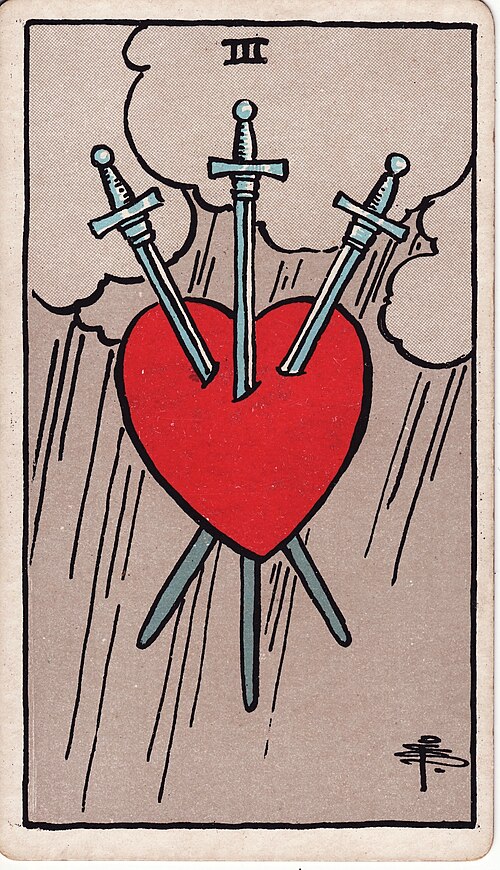
Three of Swords
Three
Traditional foundation
Traditional meaning for the Three of Swords is heartbreak. Sorrow. Grief. A piercing truth. Separation. Words that wound. That is useful. I am not going to pretend it is not. Learn it. Respect it. If this card lands in a reading about love and the room goes quiet, you are not being unsophisticated by naming heartbreak.
Keep that foundation. Then refuse to stop there. A textbook caption is not the whole card, and I am not going to replace heartbreak with a cute new caption either. Heartbreak is one true note. It is not the song.
Where it sits in the deck
Swords, not Cups. That matters. The suit is air: thought, communication, truth, conflict, decisions, clarity, worry. So the pain is in the mind and the mouth and the fact, as much as in the feeling. Why is heartbreak drawn with blades and rain, not with a spilled cup?
Number three: a painful truth. Three is more than a pair. Something has entered that two could not hold. It sits after the stalemate of the Two and before the rest of the Four. If you want the number plus the suit plus the image in one breath: three air-truths through a heart, in the rain.
A Three in another suit is a different life. Three of Cups is not this. Three of Wands is not this. Three of Pentacles is not this. Same number, different field, different picture. Do not add three plus swords on paper and call it a reading.
Look at this image
There is no person. Sit with that. A red heart hangs in a grey sky, pierced by three swords. Rain. Heavy grey clouds. The blades go through. Points down. No face to comfort you, no hands to pull the swords out. Just weather, steel, and a heart.
What caught you first? The heart, the swords, the rain, the grey? Why three swords, not one, not two, not ten? Why a heart on a Swords card at all? Why rain, and is this the same rain as a storm behind someone walking away? What are the colours doing? Red against all that grey.
What was your first impression, before you remembered the word heartbreak? What does the image make you feel? What is the energy: cold, heavy, relieving, still, theatrical, honest? Cover the traditional note. Look again. Describe only what is there.
Then ask the rest of the Method. What does the number three add? What changes when this card sits beside another one? What does the question change? What does the position change? And what does your intuition tell you, before you tidy it up?
Symbols worth investigating
A heart on an air card is already a conversation. Feeling has been put in the path of thought. The swords are the suit's own tool. They are not accidents in the picture. Someone, or something, put three blades through the centre.
Rain on the Three of Swords is not generic weather. It is falling on a pierced heart. That is a different rain from a light shower over a harbour. Ask what the rain is doing here. Grief. Cleansing. Cold. Climate. Relief. Do not decide rain equals sadness every time and miss the times it is washing the air.
Three blades. A triangle of steel. Are they three truths, three words, three people, three facts, three times you were told? The picture will not pick for you. The question might. Neighbours might. Your first hit might. Investigate. Do not file.
Colour in this card
Red heart. Grey cloud. Grey rain. Steel. That is almost the whole palette. The red is the only warmth and it is wounded. Do not write red equals passion. Write what this red is doing in this grey.
Which colour did you see first? If it was the red, you went to the wound. If it was the grey, you went to the weather. Both are in the sentence. If a neighbour card repeats this red or this rain-grey, the spread is underlining.
Number
Three. Remember these three swords. Three is not automatically creativity, or heartbreak, or a crowd. Look at how the three are arranged. They meet in the heart. A triangle is different from three in a line.
Three can be a gathering, a tension, a birth, a pattern that has started to repeat. Here, three has a target. The number started the job. The picture finished a lot of it. The question finishes the rest.
An astrological layer
Traditional tables give this card Saturn in Libra. Weight on the scales. Time, consequence, and the cost of relating. If that quality actually meets the rain and the three blades in this question, it can add a layer. If you are name-dropping a planet, stop. Traditional correspondence, not a script, and not a curse.
What is this card doing?
Heavy. Wet. Still, in the way a storm can be still at the centre. Not fast like the Knight. Not resting like the Four. The air has gone to weather. Contraction in the chest. Sometimes a strange relief, because the truth is finally visible.
There are no good cards and bad cards. This energy can be the kindest thing on the table if the question was 'what is actually going on?' It can be a rehearsal of the wound if you use it to stab the same place daily. Feel it before you fear it.
Light and shadow
Light. Finally telling the truth, finally grieving, finally letting the rain do its job. A painful clarity that stops the lying. Heartbreak named, so it can move.
Shadow. Rehearsing the wound. Stabbing the same place. Refusing to come in out of the rain. Making a personality out of being pierced. Fear is a lazy reading of this card. Unconscious looping is a real one.
How this can show up
A breakup, yes. A friendship that ends with a sentence. A diagnosis. A betrayal you can no longer un-know. Three facts that will not sit politely beside each other. Words in a message you cannot unread.
It can be grief that is mental as much as emotional: the story you told yourself is over. It can be surgery of the truth. It can be the moment you say the thing in the meeting and the room changes temperature.
It can also be quieter. Three worries that have become one ache. A headline. A memory that arrives with weather. Do not force a soap opera onto a card that might be naming a clean, awful fact.
Same card, different reading
In a reading about a breakup, the traditional heartbreak note may be exactly on the money. In a reading about work, those swords might be three sharp truths you have been avoiding. In a reading about a decision, the rain might be the relief of finally saying it. I am not giving you a new caption. I am showing you why a caption is not enough.
The card did not change. The question did. The position did. You did. Advice might be: tell the truth even if it pierces. Challenge might be: you are living in the rain on purpose. Outcome might be grief, or clarity, or both. Surrounding cards decide whether this is a wound, a surgery, or a weather system passing.
Beside the Two, the blindfold came off and this is what was behind it. Beside the Four, rest is being offered after the piercing. Beside Cups, feeling floods the air. Beside Pentacles, a practical consequence. Beside the Ten of Swords, ask whether this is a chapter or the whole book. Look. Then interpret. Then check the traditional note. In that order.
Activity
Describe before you interpret
Cover the traditional notes above. Look at the image. Write only what you see. People, objects, weather, direction, colour, what is missing. No meaning yet.
Activity
Ask the card
What caught your eye first? Why three swords, not one, not two, not ten? Why a heart on a Swords card? Why is it raining, and what is the rain doing to the heart? What are the colours doing? What was your first impression, before the word heartbreak? What does the image make you feel? What is the energy of this card in this moment? What does the number three add? What changes when this card sits beside its neighbours? What does the question change? What does the position change? What does your intuition tell you, before you tidy it up?
Practice
Practise this card
Practise the Method on this card as if you have never heard the word heartbreak. One full minute. Write: first look, swords, heart, rain, colours, number three, energy, what you feel. Then write the traditional note. Then write the sentence: I know the traditional meaning, and what is standing out to me here is... Then put it in a real question you have, and notice what shifts. Do not invent a prettier caption. See beyond the textbook.
Open the practice