Course/The Seventy-Eight Cards/Swords
Part 04
Four of Swords
Observe first. Interpret second. Research third.
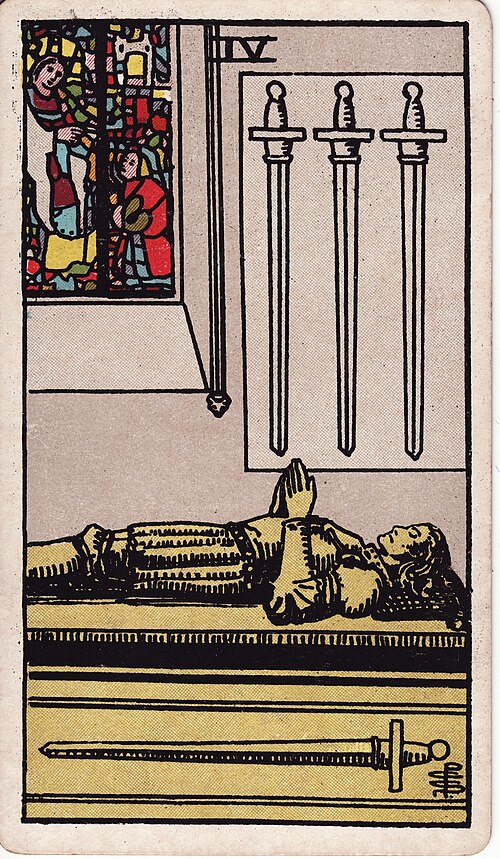
Four of Swords
Four
Traditional foundation
Traditional meaning for the Four of Swords is rest. Recovery. Retreat. A pause for the mind. Meditation. Time out after conflict. Sometimes a sickbed, sometimes a holiday, sometimes a truce you can feel in the body.
Keep that. Traditional notes also mention withdrawal, isolation, and putting the fight down. Useful. A still knight on a tomb has been read as recuperation for a long time. Learn the foundation. Then look at whether this rest is healing or hiding.
Where it sits in the deck
Four in the air suit. After the piercing of the Three, the mind is put down on stone. Number four: structure, a table with legs, sometimes stability, sometimes a box. Here the structure is a tomb in a quiet room. Rest of mind. Air that has stopped arguing for a minute.
It sits between painful truth and the mean little victory of the Five. Skip this Four and the mind goes straight back to war. Number plus suit plus image: four swords, a knight at rest, three hung up, one kept along the tomb.
Look at this image
A knight lies on a tomb, hands together as if in prayer. Grey stone. A quiet chapel. Three swords hang on the wall above him. One sword is carved along the side of the tomb. In the corner, stained glass: colour in a grey room, a kneeling figure, another figure, a window that is the only bright weather.
Is he asleep, recovering, or already a memorial? Why three swords on the wall and one on the tomb? Why stained glass and not a door? Why inside, after so many Swords that happen under sky?
First impression. Peaceful? Creepy? Relieved? Bored? The effigy is still. The room is still. Your job is to notice what kind of still this is before you fetch the word rest.
Symbols worth investigating
A tomb is a heavy bed. Rest that looks a bit like death. Ask whether this question needs you horizontal, or whether you have laid yourself out as if the story is already over. The prayer hands: surrender, petition, habit, peace. What are they doing here?
Three swords on the wall: the fight is hung up, not gone. One sword stays with the body. Even at rest, air keeps one blade. Is that wisdom or inability to put the last thought down?
Stained glass is built light. A story in colour that you cannot walk into. A window, not a door. Can this figure leave? Who is allowed in? The chapel is architecture as a choice. Quiet can be sanctuary or a locked ward.
Colour in this card
Mostly grey stone, grey armour, grey air. Then that window: gold, red, blue, a small blaze of colour in the corner. Which did you see first, the grey or the glass?
Do not file grey as depression and stop. This grey might be cool, holy, empty, safe. The colour in the window is attached to a scene of kneeling and blessing. What does that do to the tomb beneath it? If a spread is all this grey, the mind is in a stone room.
Number
Four. Structure. A room with walls. Sometimes the structure holds life up. Sometimes it pins it down. In Swords, four is rest of mind: the thoughts have been arranged, hung, laid along the edge.
Fours can feel like a box. Ask whether this box is a recovery room or a coffin you have started to like. The number is a quantity of stillness, not a moral.
An astrological layer
Traditional tables give this card Jupiter in Libra. Expansion in the sign of the scales, which here has gone inward: rest as a kind of justice to the nervous system. If that adds, keep it. If you cannot see Jupiter in this chapel, do not glue it on. Traditional layer, optional.
What is this card doing?
Slow. Horizontal. Internal. Passive in the body, not necessarily in the mind: three swords are still on the wall. Contraction of activity. Expansion of quiet, if you let it be.
It can feel like a held breath that finally went out. It can feel like numbness. Notice whether you are hungry for this card or irritated by it. Both are reads.
Light and shadow
Light. A chosen pause. The mind off the battlefield. Recovery that makes the next thought possible. Silence used as medicine.
Shadow. Withdrawal dressed up as rest. Hiding in the chapel so you never have to pick a sword up again. Becoming the effigy. Stillness that is really shutdown.
How this can show up
Sick leave. A weekend with the phone in another room. Meditation that is actually meditation, not scrolling with a candle. Sleep after the argument. A retreat. Time between the diagnosis and the plan.
It can show up as burnout insisting. It can show up as the quiet after a Three of Swords week. It can show up as lying on the sofa replaying the swords on the wall instead of sleeping.
Watch whether the rest has a window in it, or only stone.
Same card, different reading
Advice: lie down. Stop thinking at the problem. Challenge: you have been on this tomb too long. Outcome: a pause, not a prize. In a health question the traditional recovery note may be exact. In a work question it may be: if you do not rest the mind, the Five will be ugly.
In love it can be sleeping in separate rooms, or a truce, or needed space. Same effigy. Different chapel.
Beside the Three, this is aftermath. Beside the Five, rest skipped or rest after a hollow win. Beside Cups, the stained glass might be feeling leaking into the stone. Beside Pentacles, actual time off, actual bed. Look at the window. Look at the one sword still on the tomb.
Activity
Describe before you interpret
Cover the traditional notes above. Look at the image. Write only what you see. People, objects, weather, direction, colour, what is missing. No meaning yet.
Activity
Ask the card
What did you see first: the knight, the tomb, the wall of swords, or the glass? Is this rest, retreat, or a rehearsal of being finished? Why three swords on the wall and one along the tomb? What is the stained glass doing in a grey room? What kind of still is this? What does the number four add to air? What would leaving this chapel change? What does the position ask: recover, or wake up? What does your intuition say before you call it a nice rest card?
Practice
Practise this card
Practise the Four by timing three minutes of doing nothing after you pull it. Then look at the card. Write whether your nothing was recovery or shutdown. Name the three swords you hung on the wall this week, and the one you kept beside the bed. Number, suit, image: four, air, this chapel.
Open the practice