Course/The Seventy-Eight Cards/Swords
Part 06
Six of Swords
Observe first. Interpret second. Research third.
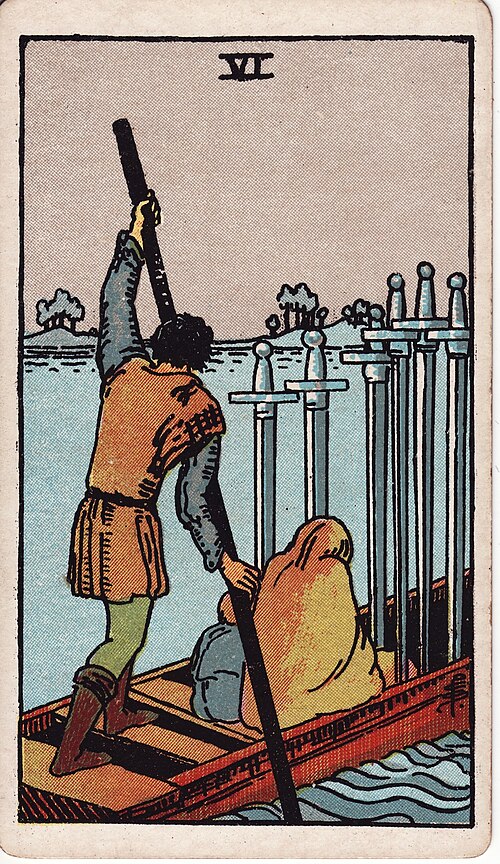
Six of Swords
Six
Traditional foundation
Traditional meaning for the Six of Swords is passage. Leaving. A journey over water toward calmer things. Transition. Moving on, often with a heavy quiet. Sometimes help from a ferryman. Sometimes recovery after conflict.
Keep that. Traditional notes have long called this a rite of going elsewhere. Useful. I will not replace it with a slogan about 'better shores' and leave you there. Look at what is in the boat.
Where it sits in the deck
Six in the air suit. After the disruption of the Five, something tries to find a way. Number six: passage, a crossing, an attempt at harmony after a mess. In Swords that harmony is not a party. It is a boat.
It sits between mean victory and stealth. You leave. You take thoughts with you. Number plus suit plus image: six swords standing in a boat, a ferryman, a woman and child, water that is still in places and choppy in others.
Look at this image
A wooden boat. A ferryman with a pole, standing, doing the work. A seated woman and a small child, hooded, backs to us. Six swords stuck upright in the boat. Water: some of it choppy, some of it quieter. Distant land. Grey cloaks. Nobody is looking at you.
What did you see first? The people, the swords, the water, the far shore? Why are the swords in the boat, not left on the bank? Why a child? Why a ferryman who is not grieving, just working?
Notice the split in the water. Leaving is not one texture. Behind and ahead are doing different weather. First impression before the word moving-on. Sad? Relieved? Numb? Practical?
Symbols worth investigating
The ferryman is a function. Someone who knows the water. Help, professional skill, a part of you that can still pole when the rest of you is hooded. Ask who is ferrying this question.
Six swords in the boat: you do not leave the thoughts on the shore. Passage is not erasure. The mind comes with you, standing up, taking space. That can be unfinished business. It can be the truths you are allowed to keep.
Woman and child, hooded, faces hidden. Vulnerability in transit. A next generation in the boat. Or a small part of you being carried. Do not automatically make it a literal mother. Ask what is being protected by the cloak.
Colour in this card
Grey-brown boat, grey water, grey sky, a strip of yellow-grey light, dark cloaks. Muted. Which colour did you even find? If something warmer sits in a neighbour card, this six may be travelling toward it or away from it.
The water's colour changes with the chop. Do not file water as emotion and stop. Ask what this water is doing: carrying, resisting, calming, threatening to take the boat sideways.
Number
Six. After a five, a way. Sometimes harmony, sometimes a story we tell to make the leaving bearable. In Swords, six is passage: air in transit, thoughts packed vertically in a small vessel.
Six can feel like relief. Six can feel like not-there-yet. Look at this six. What is being offered, and what is being asked? The number is a crossing, not a destination stamp.
An astrological layer
Traditional tables give this card Mercury in Aquarius. Mind in a cool, future-facing air sign: thoughts in transit, ideas leaving a system. If that meets the ferryman and the six blades, it can add. If you are only showing off a planet, skip it. Traditional layer.
What is this card doing?
Slow movement. Forward, not dramatic. A glide with effort in the pole. Internal for the passengers, external for the ferryman. The energy is going elsewhere even if the hearts have not caught up.
It can feel like the quiet in a car after a house move. Not happy. Not the fight. In between. Notice whether you want to rush them to the far bank. That hurry is yours.
Light and shadow
Light. Leaving what is finished. Accepting help. Carrying the necessary thoughts and letting the shore go. Passage as an honest act.
Shadow. Running away and calling it healing. Taking every sword with you so the new place is just the old mind with a different postcode. Numbing under the hood so you never feel the crossing.
How this can show up
A house move, a job change, a country, a hospital transfer, leaving a family system. Therapy as a boat. The week after the breakup when you are still packing thoughts.
It can be quieter: coming off social media, changing the route to work so you do not pass the door, taking the child and going to your sister's. Air passage is often a change of mind that then requires a change of place.
Watch what is in the boat. If you take all six swords, you will recognise the furniture when you arrive.
Same card, different reading
In love: leaving, or the quiet journey after the row. In work: a transfer, a new team, a commute that is really an escape. In healing questions the traditional recovery-over-water note may be exact. Advice: get in the boat. Challenge: you are poling in circles with a full cargo of blades.
Outcome is rarely 'arrived'. This card is the middle of the water. Neighbours tell you the shore.
Beside the Five, this is the walkers getting into a vessel. Beside the Seven, someone may be leaving with more than they admitted. Beside Cups, the water takes over. Beside Pentacles, a practical relocation. Look at the chop versus the still. Ask which water this question is in.
Activity
Describe before you interpret
Cover the traditional notes above. Look at the image. Write only what you see. People, objects, weather, direction, colour, what is missing. No meaning yet.
Activity
Ask the card
What did you see first in the boat? Why are the swords travelling with them? Who is the ferryman in this question? What is the child doing in the picture? Which water is this: choppy, still, or both? What is the energy of leaving here? What does the number six add to air? What would it mean to put one sword back on the shore? What does your intuition say before you call it moving on?
Practice
Practise this card
Practise the Six by naming six thoughts you would take in the boat if you left this situation tonight. Then cross two off. Look at the card again. Write what the ferryman would say, and what the hooded figure would not say. Passage, air, this water. One sentence that needs all three.
Open the practice