Course/The Seventy-Eight Cards/Swords
Part 05
Five of Swords
Observe first. Interpret second. Research third.
Five of Swords
Five
Traditional foundation
Traditional meaning for the Five of Swords is defeat, humiliation, a nasty little win, conflict where nobody actually feels good. Winning the argument and losing the room. Sometimes theft of dignity. Sometimes walking away.
Keep it. Traditional notes have always said this victory is hollow. I am not going to pretty that up. Mean victory is a fair name for the number in this suit. Learn it. Then look at who, in the picture, you are.
Where it sits in the deck
Five in the air suit. Something entered that the Four did not plan for. Number five often feels like disruption. In Swords that disruption is conflict with a smirk. Mean victory. Thought used to score points.
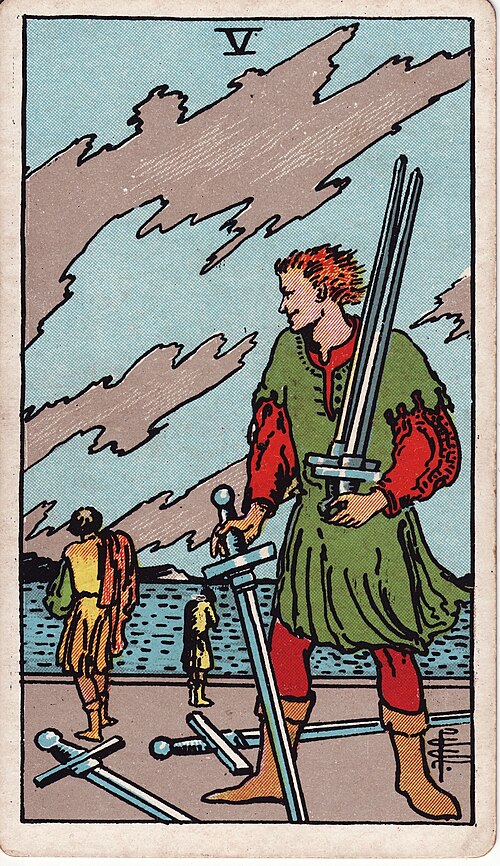
It sits after rest and before passage. If the Four was the chapel, this is the car park row. Number plus suit plus image: five swords, one figure collecting them, two people leaving under a jagged sky.
Look at this image
A figure in the foreground holds three swords, two more on the ground at his feet. He looks back over his shoulder. The face has a gloat in it, or at least a private smile. Two other figures walk away toward water, shoulders down. Stormy sky. Jagged clouds. A win that photographs like a loss.
Who did you look at first? The collector, or the ones leaving? Why is he looking back? Why are two swords still on the ground? Why is the sky doing that?
First impression. Ugly? Satisfying? Embarrassing? Tired? Do not skip the body language because you already know the keyword conflict.
Symbols worth investigating
Collected swords: taking the weapons, taking the last word, taking more than you need. Two left on the ground: leftover harm, or a prize so cheap you cannot even carry it all.
The two walking away are the rest of the sentence. A reading that only names the gloating figure is half a card. Who left? Who is still looking back from the shoreline? Water in the distance: feeling at the edge of an air fight.
The sky is part of the fight. Those clouds are not wallpaper. Jagged weather for jagged talk. Ask what the environment is doing to everyone in the picture, not just the one with the smirk.
Colour in this card
Grey-green water, bruised sky, a bit of red in the clothes, steel. The palette is unsettled. Which colour snagged you? If it was the red, follow where the red sits: on bodies, not on a heart this time.
The sky is doing a lot of the emotional work. Slate, yellow-grey, storm. Do not decode it as a traffic light. Ask whether this weather feels like triumph, shame, or weather after a row.
Number
Five. Something the four did not budget for. Disruption, conflict, the extra person in the room, the comment you cannot unsay. In Swords, five is a mean victory: air that won and did not stay kind.
Do not file five as chaos and stop. Look at this five. What broke? What was taken? What is still standing? Two people are still walking. That is not nothing.
An astrological layer
Traditional tables give this card Venus in Aquarius. Relating in a cool, airy sign: charm that can go detached, values that can go pointed. If you can see that in the gloat and the walking away, it may add. If not, do not drag Venus in because a list said so. Traditional, optional, not a moral.
What is this card doing?
Active, sour, windy. Movement in two directions: one figure planted with the swords, two in retreat. Expansion of ego, contraction of goodwill. Fast mouths. Slow shame, arriving later.
It can feel like adrenaline. It can feel like the quiet after you 'won'. Notice your allegiance. Did you side with the collector or the ones leaving? That allegiance is part of the read.
Light and shadow
Light. Knowing when a fight is not worth the air. Walking away. Or telling the truth even if it makes you the one holding the unpopular swords. Honesty without the smirk, if you can manage it.
Shadow. Humiliating someone and calling it honesty. Collecting swords you do not need. Winning the point and poisoning the well. Or staying in a fight because walking away would feel like defeat.
How this can show up
The meeting where you scored and the team is wrecked. The family WhatsApp. The breakup that became a courtroom. Online, obviously. A legal win that does not feel like a life win.
It can be you gloating. It can be you leaving. It can be you doing both in the same afternoon. Air conflict is often words, tone, timing, the last sentence you could not resist.
Sometimes the card is simply: this victory will not feed you. Put two of the swords down.
Same card, different reading
In work: office politics, a pitch stolen, a debate that should have been a conversation. In love: the row you 'won'. In a question about integrity: look at the face in the foreground and tell the truth about it.
Advice might be walk away, like the two in the back. Challenge might be you are the one collecting. Outcome might be a hollow win. Same picture. Different seat in it.
Beside the Four, someone left the chapel and went straight to the car park. Beside the Six, the ones walking may be about to get in a boat. Beside Cups, the water in the background floods. Beside Wands, ego plus blade. Look at who faces whom, and who has already turned their back.
Activity
Describe before you interpret
Cover the traditional notes above. Look at the image. Write only what you see. People, objects, weather, direction, colour, what is missing. No meaning yet.
Activity
Ask the card
Who did you identify with first, and what does that say? What is the gloating figure actually holding? Why are two swords on the ground? What is the storm doing? Is this a win, and if so, what did it cost? What does the number five add to air here? What changes if this card is the other person, not you? What would walking away look like in this question? What does your intuition say before you pick a villain?
Practice
Practise this card
Practise the Five by writing three sentences: one from the collector, one from a figure walking away, one from the sky. Then choose which voice this question actually needs. Do not decide in advance that Swords fives are 'bad'. Look at the smirk, the retreat, and the leftover blades.
Open the practice