Course/The Seventy-Eight Cards/Wands
Part 06
Six of Wands
Observe first. Interpret second. Research third.
Six of Wands
Six
Traditional foundation
Traditionally the Six of Wands is victory, public recognition, the wreath, the parade. Old books offer triumph, good news arriving, a leader being carried by the moment, progress after strife. Honour that other people can see.
Some traditional lists add: pride, a messenger of success, the hope of a fight concluded. Learn that. Then look at who is on the horse and who is on foot. A wreath is not the whole story of a card that includes a crowd.
Where it sits in the deck
Five was conflict of wills with no obvious winner. Six is public success: fire that has been seen, ranked, applauded. Number six often tries to restore harmony after a five. In Wands that harmony looks like a procession, which is harmony with a hierarchy in it.
Suit of fire, so the success is about will, courage, creative or worldly heat, not a quiet inner peace. The horse, the wreath, the raised wand with another wreath on it. You could not mistake this for the Six of Cups. A child is not offering a cup here. A rider is taking a street.
Look at this image
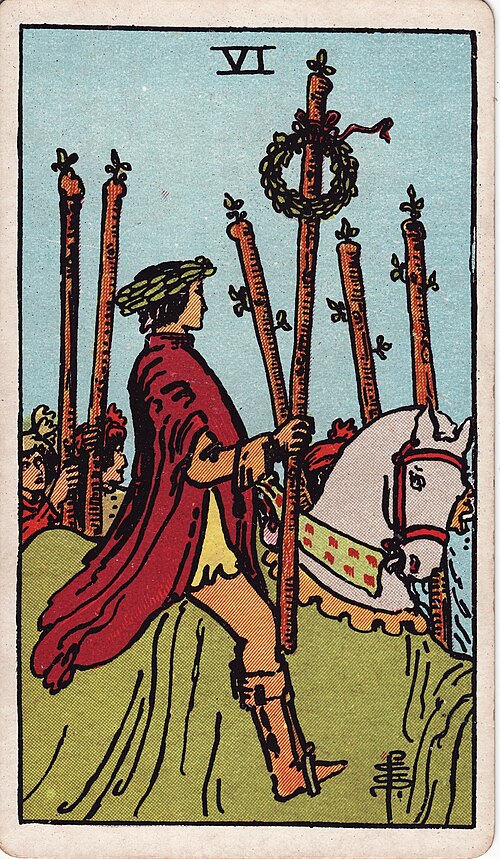
A rider comes toward us on a pale horse. A laurel wreath sits on the rider's head. Another wreath is tied to the wand held high. The horse wears a green embroidered cloth. The rider's face is composed, looking slightly our way, not wild, not charging like the Knight.
Around and behind, a crowd on foot, more wands in the air, faces, a press of people. A town wall or gateway in the back. Yellow sky again, the Wands climate. This is a street, not a desert and not a cliff. Success here needs other humans.
Notice the horse is walking. Notice the rider is elevated. Notice you cannot count how many in the crowd actually wanted this outcome. Notice the wreaths are plant, living wood made into a circle of 'we saw you win.' What did your eye go to: the crown of leaves, the horse, or a person in the crowd who is not named?
Symbols worth investigating
Laurel is traditional victory language. Two wreaths, head and staff: the person and the work both get marked. Ask who tied them. Success that you crown yourself is a different flavour from a street that did it. The card shows a public act either way.
The horse is the vehicle of the will, and it is white enough to read as a bright, visible animal, not a war-charger in full panic. Elevation is the gift and the problem. You can see further. People can throw things. The cloth on the horse is dressed-up. This win has costume.
The crowd with wands: they still have fire. They are not defeated dust. They are participating. That can be support. It can be the political fact that a leader needs a street. If you only read the rider you are doing half the image. Who is walking, and what do they get?
Colour in this card
Green wreaths and green horse-cloth against yellow air and a white horse. The green is the 'well done' colour, planted on the win. The rider's tunic is often embroidered, richer than the Five's scramble. Gold and leaf, not mud.
White horse: visibility again. You will not sneak this success through the back door. If the green is what you love in the card, you may be hungry for recognition that is living, not metallic. If the crowd's duller clothes catch you, you may be with the walkers. Colour can tell you whose side you are reading from.
Number
Six. After disruption, something tries to find a way. In Wands the way is a public story of success. Harmony, or a story we tell so the five looks worth it.
Sixes can be generous and they can be spin. Count the difference between a six that shares the street and a six that needs the street to prove the rider exists. The number does not decide. The question and the faces do.
An astrological layer
Traditionally Jupiter in Leo. Expansion of the proud heart: applause, generosity, a win that wants a stage, luck that looks like charisma. That is why this six is a parade and not a quiet nod in a corridor.
Jupiter can bless and it can inflate. Leo can warm a room and it can need the room. If this correspondence adds a warning about pride, or a permission to be seen, use it. If you are only naming a planet to sound trained, stop.
What is this card doing?
Upward, outward, witnessed. Movement at walking pace, which is slower than you might expect for victory. The charge already happened in the five or in some fight off-card. This is the reception.
Energetically it can feel like heat in the face, like relief, like 'they saw it.' It can also feel like a costume you cannot unbutton yet. Light or heavy depends on whether the wreath fits. Ask your body if it wants to get off the horse.
Light and shadow
Light. A win that is real, shared enough to be true, and worn without turning the crowd into furniture. You let yourself be seen. You remember you had help staying on the horse.
Shadow. The parade as a personality. Needing the wreath to know you exist. Taking credit for a street you did not walk. Or shrinking from a success that did happen because being visible feels unsafe, so you call humility what is actually a refusal of the six.
How this can show up
The promotion email, the prize, the show that sold, the match won, the essay that got the mark. Public. Named.
A family that finally admits you did the hard thing. Not a trophy. A room that changes how it looks at you.
Social media victory, which this card will not automatically bless. A wreath on a wand can be a laurel or it can be a brand. Surrounding cards and your honesty decide.
Being the one on the horse at work while the team walks. Or being in the crowd, holding a wand, making someone else's six possible. Both are in the picture.
Same card, different reading
As outcome it often says yes, this will be seen, and seen is not the same as finished. The Seven is defence of what the Six won. Enjoy the street. Do not move in.
In love it can be a relationship going public, a reunion with applause, or performing a romance for the crowd. Look at whether the horse is walking toward the querent or past them.
Advice position: take the win, or give the wreath where it belongs. Challenge position: pride, or a fear of being seen that is running the reading. Same wreaths. Different job.
Activity
Describe before you interpret
Cover the traditional notes above. Look at the image. Write only what you see. People, objects, weather, direction, colour, what is missing. No meaning yet.
Activity
Ask the card
Who put the wreath there, and who is still on foot? What success are you refusing to be seen in? If the crowd went home, would the win still be a win? Where are you performing victory instead of inhabiting it?
Practice
Practise this card
Sit with the Six of Wands and write two lists: what the rider gets, and what the people on foot get. Then name a real success in your life, even a small one, and put yourself in the picture honestly. Are you on the horse, in the crowd, or pretending there was no street? No false modesty. No swagger. Then look up the traditional victory note and see what matches.
Open the practice