Course/The Seventy-Eight Cards/Wands
Part 07
Seven of Wands
Observe first. Interpret second. Research third.
Seven of Wands
Seven
Traditional foundation
Traditionally the Seven of Wands is defence, valour, standing your ground. Old books talk about competition from below, a fight for position, courage in the face of opposition, holding advantage. A person on higher ground who will not come down.
You may also meet traditional notes of perseverance, of being challenged after success, of six against one. Foundation: fire that has something to protect. Then look at the hill and the mismatched feet. The picture is more interesting than the word courage.
Where it sits in the deck
Six put you on the horse with a wreath. Seven is defence of that height. Number seven often tests. In Wands the test is other people's fire pushing up from below. Not the Five's free-for-all in a flat yard. This is uneven ground. One will, six wands, a slope.
Sequence matters. If you read seven as random struggle you miss that it often follows being seen. Success attracts challenge. Suit of fire: this is not a legal brief and not a sulk. It is the body on a hill with a staff, saying no. Image plus number plus suit, or you are back on slogans.
Look at this image
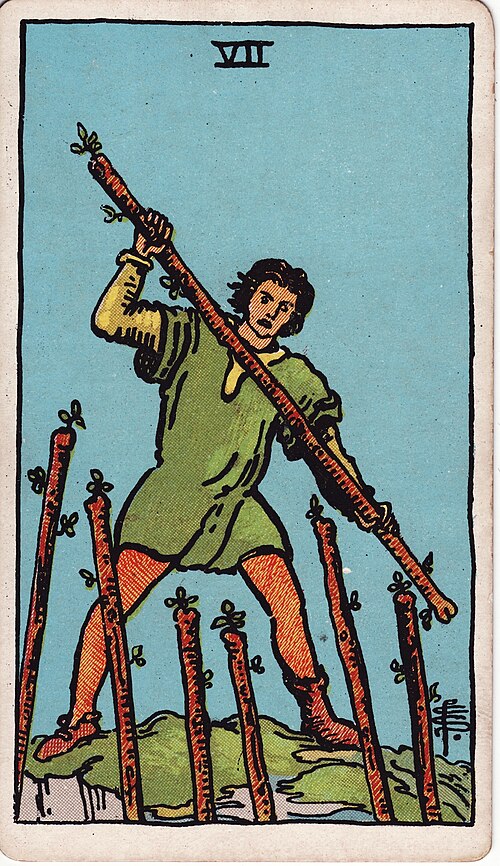
A figure stands on a green crag, higher than we are, gripping a wand with a stance and a stare that has finished with being polite. Six more wands thrust up from below, attackers we mostly do not see, only their wood. The sky is blue and broken with cloud, less desert-yellow than many Wands, more weather.
Look at the feet. In Pamela Colman Smith's picture the footwear does not match. One foot wears a boot, the other does not. Caught off guard, standing in two worlds, no time to dress for the occasion, or a person whose foundation is not as even as the hill suggests. Readers argue. You look.
The face is turned toward the incoming staves, not toward us. This is not a parade. The tunic is green, working clothes more than a wreath. What hit you first: the height, the six poles, the eyes, or those feet?
Symbols worth investigating
Higher ground is advantage and isolation. You can defend. You can also become a person who only knows how to be up. Traditional valour lives here. So does stubbornness. Ask whether the hill is a principle or a habit of never coming down to talk.
Six wands below, one above. The six can be other people, other demands, other opinions, six jobs, six family views, the comments section. They are not given faces. That can mean the opposition is impersonal. It can mean the defender has stopped seeing opponents as human. Both are possible. Context decides.
Mismatched shoes: I will not pin one moral on them. Investigate. Unprepared. Split loyalty. One foot in the Six's glory and one in the scrap. A body that ran out of the house. What does 'not matching' mean in this question? That is the work, not a caption.
Colour in this card
Green hill, green tunic, blue sky. Cooler than the yellow parade of the Six, more of the earth in it, as if fire has had to remember it stands on ground. The wands are the brown of actual wood, practical, not garlanded.
If the green feels like life, the defence may be of something living. If it feels like camouflage, the figure may be blending into the job of being under siege. Blue sky can be clarity or coldness. Ask what the weather is doing to the fight, not what blue equals on a chart.
Number
Seven. Assessment, a test, a pause that is not rest. In Wands the seven is defence: fire asked to hold, not to start, not to celebrate, not to run.
Sevens can go inner. This one is oddly outer for a seven, all stance and incoming poles. The inner work is whether you still want the hill. The number says examine. The image says while you are being poked.
An astrological layer
Traditionally Mars in Leo. Will defending the heart, the stage, the pride. Martial heat in a fixed fire sign: you will not be moved easily, and you may not notice when moving would be wise.
That correspondence explains the stance better than a generic courage keyword. Mars fights. Leo does not enjoy being lesser. Use it to ask what pride is in the defence. Skip it if the question is a simple boundary with no audience involved.
What is this card doing?
Tense, braced, upward. Active defence rather than attack, though the line is thin. Not the Five's scatter. A single point of heat holding against many. Breath high in the chest. Jaw set.
It can feel righteous. It can feel exhausting. If you feel heroic, check the shoes. If you feel bullied, check the hill: advantage is still advantage. Energy here is stamina with an edge, not a spark and not a party.
Light and shadow
Light. A clean no on ground you actually have a right to. You hold the staff, you keep your dignity, and you know what you are defending, not only that you are defending.
Shadow. Life as a hill. Every conversation is six wands. Pride that cannot come down, or a siege you are feeding because without opponents you do not know who you are. Also: refusing to defend anything, calling it peace, while the staves take the ground.
How this can show up
The week after the win, when the inbox fills with challenge, nitpick, 'actually.' The Six's crowd has opinions now.
A boundary with family, a creative vision under critique, a parent standing on a principle while relatives push from below.
Self-employment, one person, six clients' fires. Higher ground as being in charge. Siege as the calendar.
Inside: defending a new habit, a recovery, a truth you only just said, against older parts of you that still have wands.
Same card, different reading
As advice this often says hold. As a challenge it says you are holding as a lifestyle. As outcome it can mean the point will be contested, not that you will lose.
In love it may be defending the relationship to outsiders, or defending yourself inside it. Look at whether the six wands have faces you know. Neighbour cards that are Cups ask if the hill is loneliness dressed as principle.
After Six, this is the cost of being seen. Before Eight, this is the last stand before something has to move fast. If the Eight follows, you may not need to hold the hill forever. Movement is coming.
Activity
Describe before you interpret
Cover the traditional notes above. Look at the image. Write only what you see. People, objects, weather, direction, colour, what is missing. No meaning yet.
Activity
Ask the card
What exactly are you defending, in one sentence? Is this higher ground a principle or a personality? What do the mismatched feet want you to notice? If you came down the hill, what would you lose, and what would you gain?
Practice
Practise this card
Stand on a real step, a stool, a hill if you have one, with the Seven of Wands. Feel the height for thirty seconds. Write the six wands coming at you this month as six short names: people, demands, doubts. Then write the one staff in your hands. Circle which opponents are real and which you have promoted to a siege because it makes you feel like a figure on a crag. Traditional valour last, not first.
Open the practice