Lesson 01
Observe first. Interpret second. Research third.
Observe first. Interpret second. Research third.
You know the cards. Now learn to actually see them.
Observe first. Interpret second. Research third. If you take one habit from this whole school, take that. The minute you get nervous you will sprint to a book and abandon your own eyes. I want the eyes to go first, even though you now have knowledge.
Why this comes after the deck
If I had taught this first, you would have described rain and missed that you were in Swords. You have the language now. Suit, number, Major neighbourhood, traditional note. That knowledge is a gift. It is also a thief. It will try to caption the card before you have looked.
So the order still holds, and it holds more tightly than it did when you were a beginner. Observe what is on this picture. Interpret it in this question, using what you know. Then research: library, notes, correspondences, anything that deepens or corrects. Research last, so it cannot steal the looking.
The three moves
Observe. What is actually there? People, objects, weather, colour, direction, movement, stillness, what is present, what is missing. Your first reaction. What caught you. How the card feels in the body. No meaning yet. Accountable to the picture.
Interpret. Now you may mean. What do you think this is doing, given the question, the position, the cards around it, the traditional note you already hold, and what you just saw? Interpretation is accountable to the question as well as the picture. It is a claim. Make it, and be able to point at the image when you do.
Research. Then, and only then, open the Tarot Library. Check the traditional layer. Check your own earlier notes. If astrology or number or a law is actually speaking, look at it. Research is how you stay honest, not how you get the answer so you can skip seeing.
What observing can include, when you slow down
Look at the card. Notice your first reaction. Notice what catches your attention. Observe the imagery. Colours. Symbols. Numbers. Characters. Body language. Faces. Direction. Movement. Stillness. Environment. What is present. What is missing. How the card feels energetically. What you feel in yourself.
You will not run a full inventory every time. This is not a performance. It is a reminder that there is more in the picture than the title you can now recite.
Three of Swords, through the three moves
You know this card. Heartbreak, Swords, Three. That knowledge will try to finish the job in two seconds.
Observe anyway. Heart. Three blades. Rain. No person. No ground. Grey. The wound floating. Your stomach maybe dropping. That is observation. You have not said heartbreak yet.
Interpret. In a question about a friendship, you might say: something true has gone through the bond, and nobody is in the picture attending it. That uses the traditional note and the looking. It is a claim about this question.
Research. Then open the library. See what matches. See what you missed. Do not let the library overwrite the unattended wound if that was the true thing you saw.
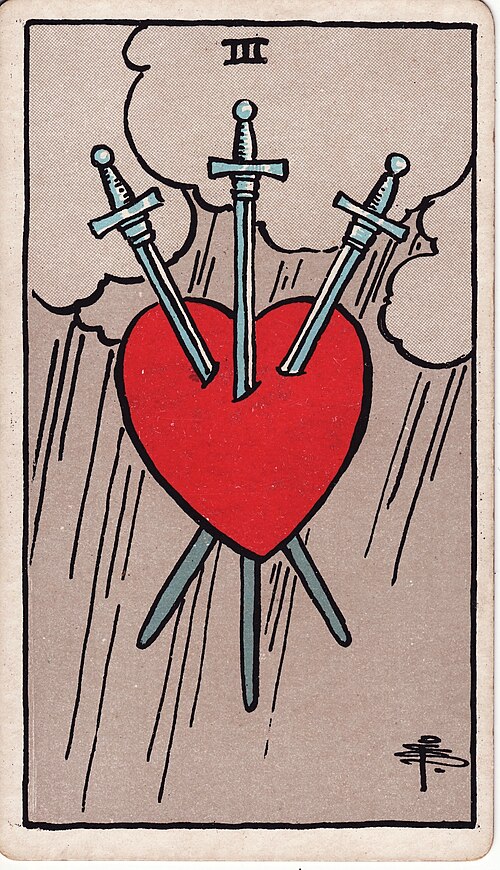
Three of Swords
Three
Observe first
Walk the three moves on a card you know
Open the Three of Swords, or pull a card you think you have mastered. Do not research it yet. Move through these layers. Messy is fine. Clever is not required. Interpretation waits until the layers have had a turn.
First look
What hit you first?
Symbols
What symbols are standing out?
Colours
What colours are drawing you?
Numbers
What numbers are present?
Body language
What is the body doing?
Facial expression
What is the face telling you?
Environment
What is the landscape or room doing?
What is present
What is here?
What is missing
What appears to be missing?
Energy
How does this card feel? Still or moving, tight or open?
Your intuitive response
What do you know, before you tidy it up?
Practice
Research third
Only now open the Tarot Library for that card. Write what matches what you already saw, and what the book says that you did not see. Neither one gets to bully the other. Then write one sentence of interpretation for a question you actually have.
Open the practiceRelated in the school
Reflection